Texas Ag Exemption for a Homestead: Small-Acreage Guide (2026)
Texas ag exemption for a homestead: 1-d-1 valuation needs 5 of 7 years of ag use at county intensity. No state minimum except bees (5 to 20 acres).
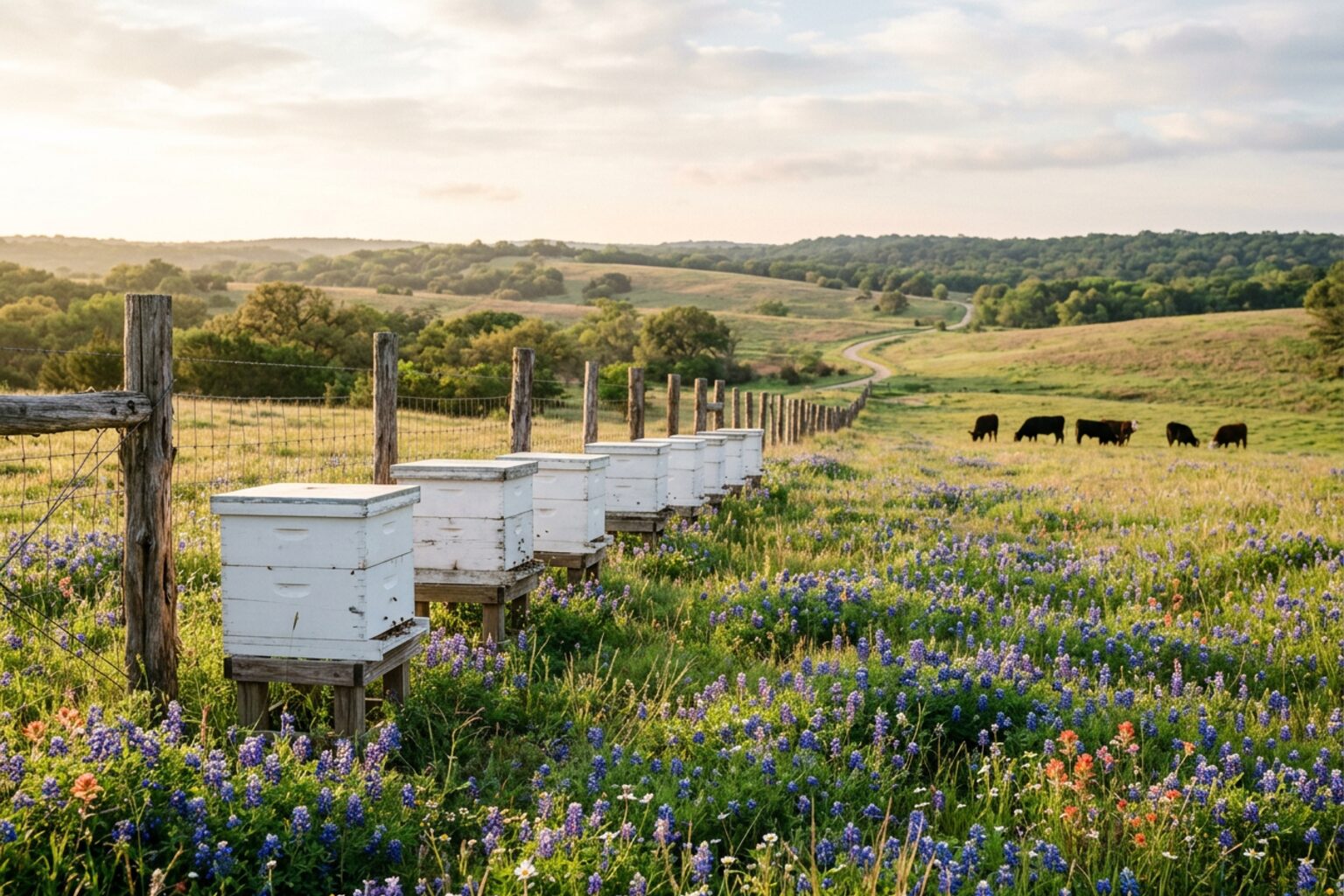
The Texas ag exemption for a homestead is really 1-d-1 open-space valuation: your land is taxed on what it can produce, not its market value. To qualify, it must be in agricultural use for 5 of the past 7 years at your county’s typical intensity. There is no statewide minimum acreage except beekeeping, which requires 5 to 20 acres.
The savings can be large. The Texas Comptroller’s special valuation fact sheet puts the statewide average market value of land in productivity valuation at $3,762 an acre in 2024, against a productivity value of $86. The trade-off is a rollback tax if you stop farming, and county appraisal districts set their own acreage guidelines.
Is the Texas ag exemption actually an exemption?
No. It is a special appraisal, and the Comptroller says so plainly. Your land keeps a market value on the tax roll, but you pay tax on a lower productivity value.
The Comptroller’s fact sheet explains that productivity value is based on the net income an owner using ordinary prudence would earn, averaged over a five-year period, divided by a capitalization rate. For 2026 values, the five years are 2020 to 2024. The appraisal applies to land and appurtenances, not to improvements like your house or barn.
Texas has two versions. Almost every homesteader uses 1-d-1 (open-space), approved in 1978. The older 1-d (agricultural use) requires that agriculture be your primary occupation and income, and selling 1-d land triggers a rollback. Under 1-d-1, there is no income or occupation test, and corporations as well as individuals can qualify.
How many acres do you need for an ag exemption in Texas?
State law sets no minimum for most uses. In practice, each appraisal district publishes guidelines, and most small-acreage owners need roughly 10 to 25 acres of pasture or about 5 acres for beekeeping or orchards.
The Comptroller’s Manual for the Appraisal of Agricultural Land (October 2024) says a blanket rule such as “no parcel under 10 acres qualifies” is invalid. But a chief appraiser may set minimum tract sizes for each land class based on the typical operation in the area. The manual’s example is a district that finds it takes 22 acres of grazing land to support one animal unit. It also says tethering a cow, keeping a chicken coop, or raising a small pen of goats cannot by itself qualify land.
What are the minimum acres by county?
Here is what three appraisal districts publish. Check your own district’s current guidelines before you buy.
| County (appraisal district) | Pasture | Other uses | Wildlife |
|---|---|---|---|
| Austin County (2026 guidelines) | Improved pasture: typically 10 acres. Native pasture: 30–50 acres | Orchard: 5 acres. Dry cropland: 50. Irrigated cropland: 100 | 16.6 acres |
| Bastrop County (ag manual) | 5 animal units minimum: 15 acres improved, 25 acres native | Irrigated orchard: 5 acres. Dry orchard: 10. Row crops: 13–16 | See TPWD ranges below |
| Wise County (2024 guidelines) | More than 5.01 acres unimproved, or 6.01 acres with no more than 1 acre of improvements; minimum 2 animal units | Fields, orchards, vineyards: 5 acres typical. Vegetables: 3 acres | 14.30 acres, or 12.50 in a wildlife association |
Wise County’s rule shows a common detail: the area under your house, driveway, and buildings does not count toward the minimum. If you plan to build, buy enough land that the minimum still holds after you subtract your home site.
What is the 5-of-7-year rule?
Land must have been devoted principally to agricultural use for at least 5 of the 7 years before you apply. The years do not have to be consecutive.
The Comptroller’s agricultural appraisal page sets out the rule. The appraisal manual adds a useful nuance: the degree-of-intensity test does not apply to those preceding years, only to the year you apply and every year after. So history counts even if past use was light, as long as agriculture was the principal use.
Decision rule for buyers: buy land that is already qualified and keep it in the same use. Under 1-d-1, the Comptroller says a new owner must reapply after a change of ownership, but the land’s history carries forward. Buying land with no ag history means waiting about five years and paying market-value taxes in the meantime, unless the land’s history can be documented.
Can beekeeping qualify for an ag exemption in Texas?
Yes, on 5 to 20 acres. Beekeeping is the only use with a statutory acreage range, written into Tax Code Section 23.51(2).
Appraisal districts set the hive count. Both Bastrop CAD and Wise CAD use 6 hives on the first 5 acres plus one hive per additional 2.5 acres, reaching 12 hives at 20 acres. Austin CAD typically expects 6 to 12 hives, kept alive and maintained, and says beekeeping can be used to establish agricultural history. Wise CAD notes that House Bill 4538, effective September 1, 2023, removed the six-colony minimum from the state definition of an apiary, though Wise kept 6 hives as its intensity standard.
Can you use wildlife management instead of livestock?
Yes, but only on land that already qualifies for ag or timber appraisal when you switch. You then run a wildlife plan using at least 3 of 7 approved practices.
Per the Comptroller’s manual, the seven practices are habitat control, erosion control, predator control, supplemental water, supplemental food, providing shelters, and census counts. TPWD says there is no minimum acreage for wildlife use unless the tract has been reduced in size since January 1 of the preceding tax year. That usually happens when a larger ranch is split and sold. Then the chief appraiser picks a minimum from a range set for your ecoregion.
| Wildlife appraisal region | Minimum acreage range (standard) | Range in a wildlife association |
|---|---|---|
| Blackland Prairie, Post Oak Savannah, Pineywoods, Upper Gulf Coast | 12.5–16.7 acres | 10–11.1 acres |
| Cross Timbers, Edwards Plateau (Eastern) | 14.3–20 acres | 11.1–12.5 acres |
| Edwards Plateau (Western), South Texas Plains, Rolling Plains, Lower Gulf Coast | 25–50 acres | 16.7–20 acres |
| High Plains | 25–50 acres | 16.7–25 acres |
| Trans-Pecos | 33.3–100 acres | 20–25 acres |
Source: TPWD wildlife use requirement ranges, under 34 Tex. Admin. Code §9.2005.
What is the rollback tax in Texas?
A rollback tax is triggered when you stop agricultural use or change the land to a non-agricultural use. It recaptures the difference between the taxes you paid and the taxes you would have paid at market value for the three preceding years.
The Comptroller’s fact sheet gives a statewide example for 50 acres, based on county taxes only: $85 paid on productivity value in 2024 versus $3,713 at market value, for a three-year rollback of $9,717. Key points under 1-d-1:
- Selling alone does not trigger it. Under 1-d-1, rollback applies only when ag use stops or the use changes. Selling 1-d land does trigger one.
- Your home site will not trigger it. The manual says an owner may use the land as part of a residence homestead without triggering a rollback.
- Interest: the manual lists no annual interest on a 1-d-1 rollback, while 1-d rollbacks accrue 1 percent per month. Unpaid rollback taxes become delinquent and pick up the usual penalties and interest.
- Notice: you must tell the chief appraiser in writing before May 1 if the use changes or eligibility ends, or face a penalty, per the fact sheet and Form 50-129.
How is ag valuation different from the residence homestead exemption?
They are separate tools that stack. The residence homestead exemption removes value from your house and up to 20 acres around it. Ag valuation lowers the appraised value of qualifying land.
| Feature | 1-d-1 ag valuation | Residence homestead exemption |
|---|---|---|
| What it is | Special appraisal at productivity value | Exemption of a set amount of value |
| What it covers | Qualifying land, not buildings | Your home plus up to 20 acres used with it |
| Main requirement | Ag use 5 of 7 years at local intensity | Your principal residence |
| Amount | Taxed on productivity value | $140,000 off school taxes; $60,000 more if 65+ or disabled |
| Form and deadline | Form 50-129, by April 30 | Form 50-114, generally before May 1 |
| If you stop qualifying | Three-year rollback tax | Exemption ends; no rollback |
Sources: the 20-acre limit is in Tax Code §11.13(j). The $140,000 and $60,000 school exemptions and the optional local exemption of up to 20 percent are on the Comptroller’s exemptions page. Deadlines are from the fact sheet and exemptions page.
How much can a small homestead save? A worked example
Take a 20-acre tract with a 1-acre home site and 19 acres of qualified pasture. Using the Comptroller’s 2024 statewide averages of $3,762 market and $86 productivity per acre, ag valuation cuts the taxable land value by about $69,800 ($3,676 times 19). At an assumed combined tax rate of 1.8 percent, that is about $1,260 a year. A three-year rollback on the same land would be roughly $3,800. These are our calculations on statewide averages and an assumed rate; your district’s values and rates will differ.
How do you apply for ag valuation?
File Comptroller Form 50-129 with the appraisal district in each county where the land sits, by April 30. The chief appraiser can extend the deadline up to 60 days for good cause if you ask in writing.
- Get your district’s current ag guidelines and confirm the minimum acres and intensity for your planned use.
- Gather proof of history: leases, sale receipts, hive logs, or the prior owner’s records.
- Run the operation at the local intensity: stocking rate, hive count, or crop practices.
- File Form 50-129, and Form 50-114 for the homestead exemption on your residence.
- Keep records every year. Under 1-d-1 you reapply only when ownership changes or the chief appraiser asks.
If the district denies you, the Comptroller says it must explain each reason in writing, and you can protest to the appraisal review board.
What should you plan for before buying land for an ag exemption?
Budget for the operation that keeps the valuation, not just the land. Livestock need water and fencing, and every home site needs a well and septic system.
- See how much land you need for a homestead to match acreage to stocking rates.
- Water for livestock usually means a well. Start with well drilling in Texas and the cost to drill a well.
- Read our guide to buying rural land and ask the seller for the property’s ag history before closing.
- Price the whole first year with our cost to start a homestead guide, and follow the raw land to homestead checklist for build order.
Bottom line: Texas ag valuation taxes land on its productivity, often a few percent of market value. You need 5 of 7 years of ag use and your county’s minimum intensity, which typically means 10 to 25 acres of pasture or 5 to 20 acres of bees. Stopping ag use costs three years of back taxes. Claim the residence homestead exemption on your house and up to 20 acres as well.
Frequently asked questions
What is the minimum acreage for an ag exemption in Texas?
State law sets no minimum except for beekeeping, which needs 5 to 20 acres. Appraisal districts set guidelines by land use. Austin County typically wants 10 acres of improved pasture, Bastrop County 15 acres improved or 25 native, and Wise County just over 5 acres, not counting the home site.
Can I get an ag exemption on 5 acres in Texas?
Possibly. Beekeeping qualifies on 5 to 20 acres with typically 6 hives on the first 5 acres. Orchards and small crop fields can qualify on about 5 acres in some counties. Grazing usually needs more land, because districts require a minimum number of animal units at local stocking rates.
How far back does the Texas rollback tax go?
Three years. The rollback equals the difference between taxes paid on productivity value and taxes that would have been paid on market value for the three years before the change in use. Under 1-d-1, selling the land alone does not trigger it, and using part as your homestead does not either.
Do I have to wait five years to get ag valuation on land I just bought?
Not if the land already has qualifying history. The rule is ag use in 5 of the 7 years before you apply, and prior owners’ use counts. A new owner must reapply. Land with no ag history generally waits about five years at market value.
Can I have both the homestead exemption and ag valuation?
Yes. The residence homestead exemption covers your home and up to 20 acres used with it, including a $140,000 school tax exemption. Ag valuation applies to qualifying land. The Comptroller’s manual says using land as part of your residence homestead does not trigger a rollback.
Updated October 2026. This is general information from the Comptroller, Texas statutes, TPWD, and appraisal district guidelines linked in this guide. It is not tax or legal advice. Your county appraisal district makes the final call.