Homesteading for Beginners: A First-Year Plan for Texas (2026)
Homesteading for beginners: a season-by-season first year in Texas. Water and septic in fall, shelter in winter, chickens in spring, goats in summer.
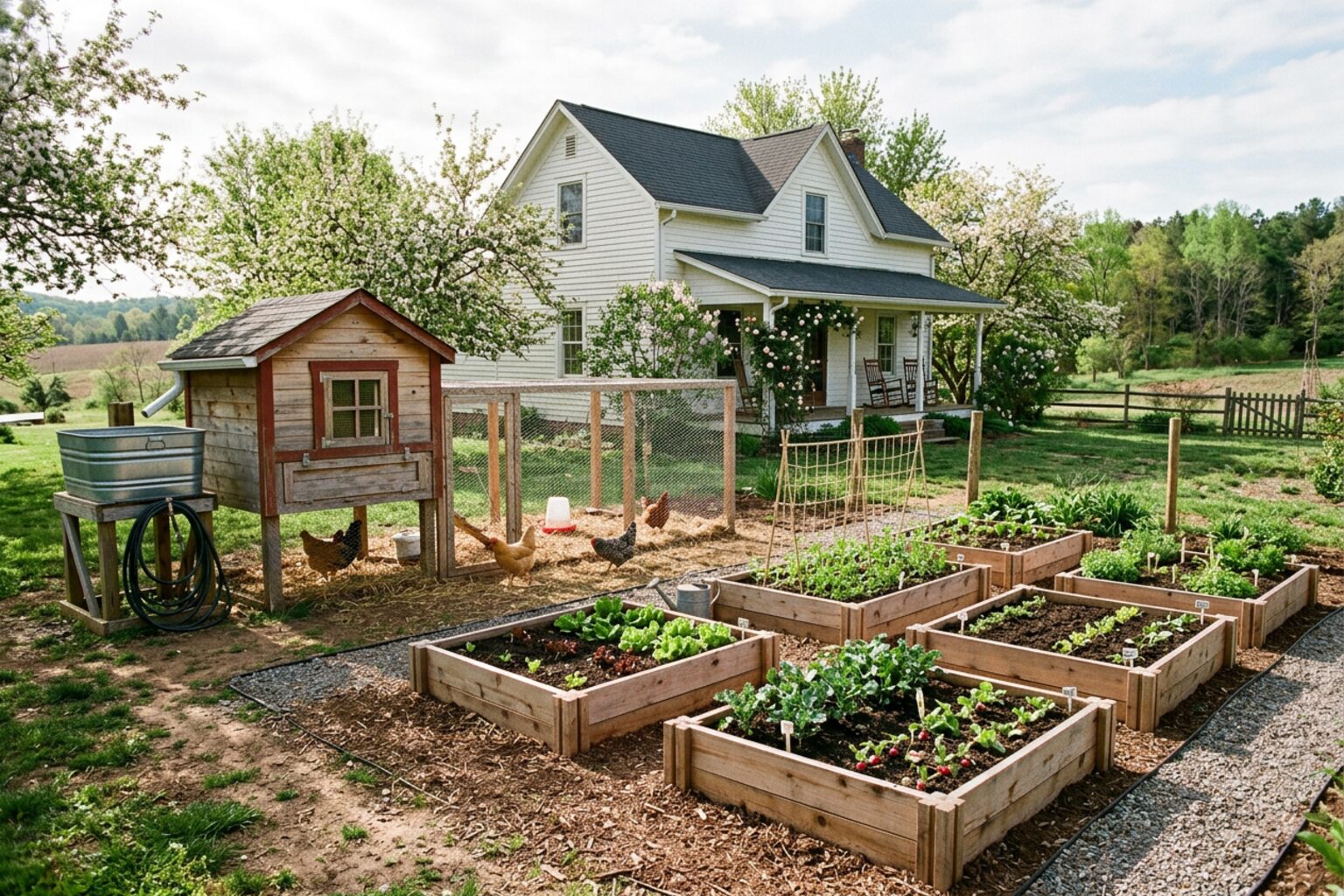
A homesteading for beginners first-year plan in Texas goes water first, then shelter, then a garden, then small livestock. Start the well, septic, and power in fall, build shelter and fencing in winter, add chickens and a spring garden, and bring in goats once fences are tight. Infrastructure alone runs about $24,000 to $92,000 on our estimate.
That budget comes from published Texas prices for wells, septic systems, power, coops, and fencing, added up in the table below. The plan assumes you take possession in late summer or fall, which lines up with Texas’s fall garden season. Shift it by a season if you close in spring.
What should a beginner homesteader do first?
Secure water first. Every later step, from building to gardening to livestock, depends on a reliable supply, and a well is the slowest and most expensive piece to sort out.
Then follow this order for the first year:
- Water and wastewater: well, septic permit and system.
- Power and access: electric service or an off-grid system, plus a driveway.
- Shelter: a place to live and a dry building for tools and feed.
- Garden: start small with a fall or spring planting.
- Chickens: a coop and a few laying hens.
- Goats or other grazers: only after fencing, shelter, and water are in place.
Decision rule: never buy an animal before its water, fence, and shelter exist. AgriLife’s small acreage livestock guide calls predators the biggest problem in sheep and goat production, and a weak fence is the usual way they get in.
Fall: how do you get water, septic, and power in place?
Use fall to lock in the systems that take permits and contractors. Drill the well, file for the septic permit, and start the co-op’s line extension process at the same time, because each one can take weeks to months.
How much does a well cost in Texas?
Central Texas builders publish $18,000 to $25,000 around Waco and $15,000 to $35,000 in the Hill Country, where depth varies. Read the cost to drill a well for depth-based pricing and our guide to well drilling in Texas before you call drillers. If the well comes in weak, a storage tank for a low-yield well can carry peak demand.
What does septic cost on a new homestead?
Central Texas installs run $4,500 to $12,700 for conventional and $10,000 to $20,000 for aerobic, per Cornerstone Septic, and aerobic systems add $400 to $700 a year in maintenance. A licensed site evaluator’s soil report decides which you can use. Our guide to aerobic vs. conventional septic in Texas explains the difference.
How much does it cost to get power?
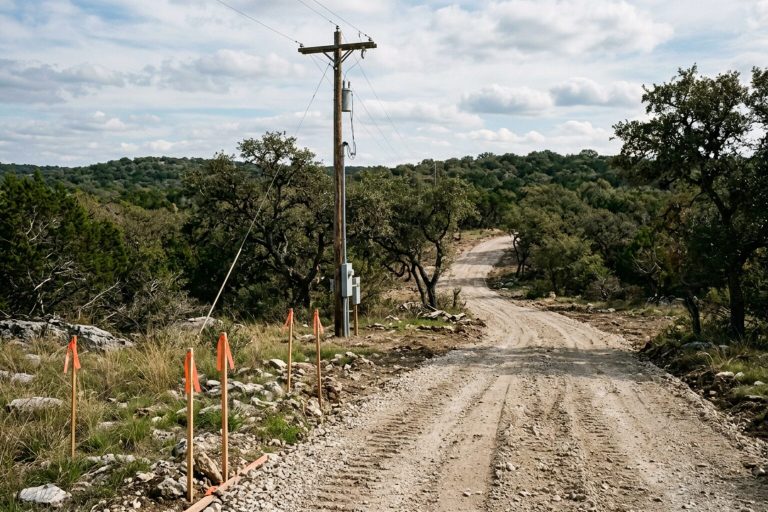
Short connections cost about $3,000 to $7,200 in Medina Electric Cooperative’s samples, and long Hill Country runs can reach $30,000 or more. Compare a line extension with off-grid solar cost before you commit.
What can you plant in a Texas fall garden?
Plenty. AgriLife’s Fall Vegetable Gardening Guide says most of Texas can grow a fall garden. Its planting table divides the state into five regions, from Region I, which plants earliest, to Region V, which plants latest. Broccoli and cabbage go in from July 15 in Region I to November 1 in Region V. Spinach runs from August 15 to December 15, and turnips from September 1 to December 15. A small fall bed in your first season teaches you your soil before spring.
Winter: what shelter and fencing do you need?
Winter is for building: a place to live, a dry building for feed and tools, a chicken coop, and perimeter fencing. Cool weather makes outdoor work easier, and fences must be finished before animals arrive.
Where will you live?
Many beginners live in an RV or a finished shop while the house goes up. Counties often treat an occupied RV as a residence that needs a permitted septic system, so read living in an RV while building in Texas first. If you build a barndominium, KC Construction publishes $50 to $65 per square foot for a steel shell on a slab around Waco and $85 to $130 for a standard finished build. See our barndominium cost in Texas guide and our list of barndominium builders in Central Texas.
What kind of fence do goats need?
Net wire, not barbed wire. AgriLife’s EB-6091 says barbed wire alone is not suitable for goats or sheep and recommends 39- to 48-inch net wire with vertical stays 12 inches apart. A barbed strand low on the outside helps stop predators from digging under.
HomeAdvisor puts woven wire fencing at $1.50 to $6 per linear foot installed and notes that one acre has a perimeter of about 835 feet. That puts a 1-acre goat paddock at roughly $1,250 to $5,000 (our multiplication). For cattle, HomeGuide prices 4- to 6-strand barbed wire at $3 to $6 per linear foot, about $2,000 to $2,200 for a single acre.
How big a chicken coop do you need?
Plan on 2 to 4 square feet per bird at minimum, per AgriLife poultry specialist Greg Archer, with perches about 18 inches high. HomeGuide puts a DIY A-frame or chicken tractor at $250 to $700 and a walk-in coop at $700 to $1,500. A walk-in coop is easier to clean and easier to make predator-proof.
Spring: when should you start chickens and the main garden?
Spring is the season for chicks and your first full garden. Get chicks in early spring so they are feathered and outdoors before the summer heat.
How do you care for baby chicks?
Chicks cannot regulate their own body heat for the first two to three weeks, per AgriLife. Keep them at about 90 to 95 degrees the first week, then lower the temperature 5 degrees each week. AgriLife’s Small Laying Flock guide calls for 1 square foot of floor per chick and 3 square feet per adult hen. Archer suggests heat-tolerant breeds for Texas, such as Leghorns, Plymouth Rocks, Wyandottes, and Orpingtons, and says heat-sensitive Jersey Giants do poorly.
How big should your first garden be?
Start small. AgriLife’s Planning a Garden warns that a garden that is too large is too much work for first-time gardeners. Its per-person table suggests 3 tomato plants, 3 pepper plants, and 10 to 15 feet of row each for beans, greens, carrots, and similar crops for fresh eating. On our math, that is roughly 350 to 450 square feet per person. Our guide to how much land you need for a homestead shows the full calculation.
Summer: when is it safe to add goats?
Add goats once the fence, shade, and water are proven. Summer heat is the hardest season on new animals, so have shelter and a reliable water supply working before they arrive.
How much shelter and land do goats need?
EB-6091 calls for 10 to 12 square feet of sheltered area per mature animal, with solid walls on the north and west, and says dense brush can also provide protection. Seven 100-pound does equal one animal unit. Depending on your region and pasture, one animal unit needs about 3 to 6 acres of tame pasture or 20 to 35 acres of native range, per the stocking rates in our land guide. Start with a few does and grow only as your pasture allows.
What garden work happens in summer?
Plant your fall tomatoes and peppers. AgriLife’s fall guide lists tomatoes from June 1 in Region I to August 1 in Region V, with last optimum transplant dates from June 25 to September 1. Then the cycle repeats with fall greens.
How much does the first year of homesteading cost?
On our estimate, core infrastructure and starter livestock facilities run about $24,000 to $92,000, before any house. The well and power line drive most of that range.
| Item | Season | Published range | Source |
|---|---|---|---|
| Water well | Fall | $15,000–$35,000 | KC Construction; CMW |
| Septic system | Fall | $4,500–$20,000 | Cornerstone Septic |
| Electric service | Fall | $3,000–$30,000+ | Medina EC; CMW |
| Chicken coop | Winter | $250–$1,500 | HomeGuide |
| Goat fencing, 1-acre paddock | Winter | $1,250–$5,000 | Our math from HomeAdvisor per-foot pricing |
| Total before housing | About $24,000–$92,000 | Our sum | |
| Optional: 1,000 sq ft barndo shell on slab | Winter | $50,000–$65,000 | Our math from KC Construction’s $50–$65/sq ft |
Feed, seed, animals, tools, and a driveway are extra. For a fuller budget, including land, see our cost to start a homestead guide. For the build sequence on raw land, use our raw land to homestead checklist.
What mistakes should beginners avoid in year one?
Most first-year problems come from doing things out of order or too big. These are the common ones the sources above warn about.
- Too much garden: AgriLife warns that oversized gardens become too much work. Grow what fits your time.
- Too many animals: EB-6091 says small acreage landowners usually overestimate their carrying capacity.
- Barbed wire for goats: it does not hold them; use net wire.
- Skipping the soil evaluation: it decides your septic type and can add $10,000 or more to the budget.
- Ignoring the ag valuation clock: Texas ag valuation requires 5 of 7 years of agricultural use. If you plan to qualify, keep records from day one. See our guide to the Texas ag exemption for homesteads.
Before you buy, our guide to buying rural land covers water, access, and soil checks.
Bottom line: In your first year, put water, septic, and power in during fall, build shelter, fencing, and a coop in winter, add chicks and a garden in spring, and bring in goats in summer once fences and water are proven. Budget about $24,000 to $92,000 for infrastructure before housing, and start every enterprise smaller than you think you need.
Frequently asked questions
What is the first thing to do on a new homestead?
Secure water. A well is usually the most expensive and slowest system to set up, costing $15,000 to $35,000 in Central Texas per local builders, and construction, gardens, and animals all depend on it. File for your septic permit and start the electric co-op’s process at the same time.
How much does it cost to start a homestead in Texas?
On our estimate, a well, septic system, power, a chicken coop, and a 1-acre goat paddock cost about $24,000 to $92,000 before housing or land. A 1,000-square-foot barndominium shell on a slab adds about $50,000 to $65,000 at Waco-area prices of $50 to $65 per square foot.
What animals should a beginner homesteader start with?
Chickens. They need only 2 to 4 square feet of coop space per bird, per AgriLife, and a starter coop costs $250 to $700 to build. Add goats after net-wire fencing, shelter, and water are in place, because goats need far more land, fencing, and predator protection.
When should I plant a garden in Texas?
Texas supports two seasons. AgriLife’s fall guide lists broccoli and cabbage from July 15 in its earliest region to November 1 in its latest, and spinach and turnips into mid-December. Plant the spring garden after your last frost. A small fall bed is a good first-year start.
Do goats need special fencing?
Yes. AgriLife says barbed wire alone is not suitable for goats and recommends 39- to 48-inch net wire with stays 12 inches apart. Woven wire costs $1.50 to $6 per linear foot installed per HomeAdvisor, or about $1,250 to $5,000 to fence a 1-acre paddock.
Updated October 2026. Costs are published ranges from the sources linked. Totals that combine them are our estimates. Nothing here describes our own homestead; it is a plan built from extension and county guidance.