Raw Land to Homestead Checklist for Texas (2026)
Raw land to homestead checklist for Texas: survey, soil test, septic permit, well, power, driveway, then build. Site work runs about $28K to $105K.
A raw land to homestead checklist in Texas follows this order: survey, soil evaluation, septic (OSSF) design and permit, well, electric service, driveway, then build. On our estimate, site work runs about $28,000 to $105,000 before the house, and the whole process takes roughly 10 to 20 months from closing to move-in.
The order matters because each step depends on the one before it. The septic design needs the survey and a soil evaluation, and counties want the well, power line, and driveway drawn on the same site plan. Bastrop County, for example, requires its septic designs to show water wells, overhead electric lines, driveways, and every existing and proposed structure.
What is the order of operations from raw land to move-in?
Do the steps that can kill the project first: legal access, survey, and soil. Then lock in water, wastewater, and power before you commit to a house plan.
- Due diligence before closing: legal tract, access, floodplain, deed restrictions, city limits or ETJ.
- Boundary survey: confirms corners, easements, and acreage.
- Soil evaluation: a licensed site evaluator decides what septic system the land can take.
- Site plan: place house, septic, well, power, and driveway together.
- OSSF design and permit: filed with your county or authorized agent.
- Water well: drilled early so you have water for construction.
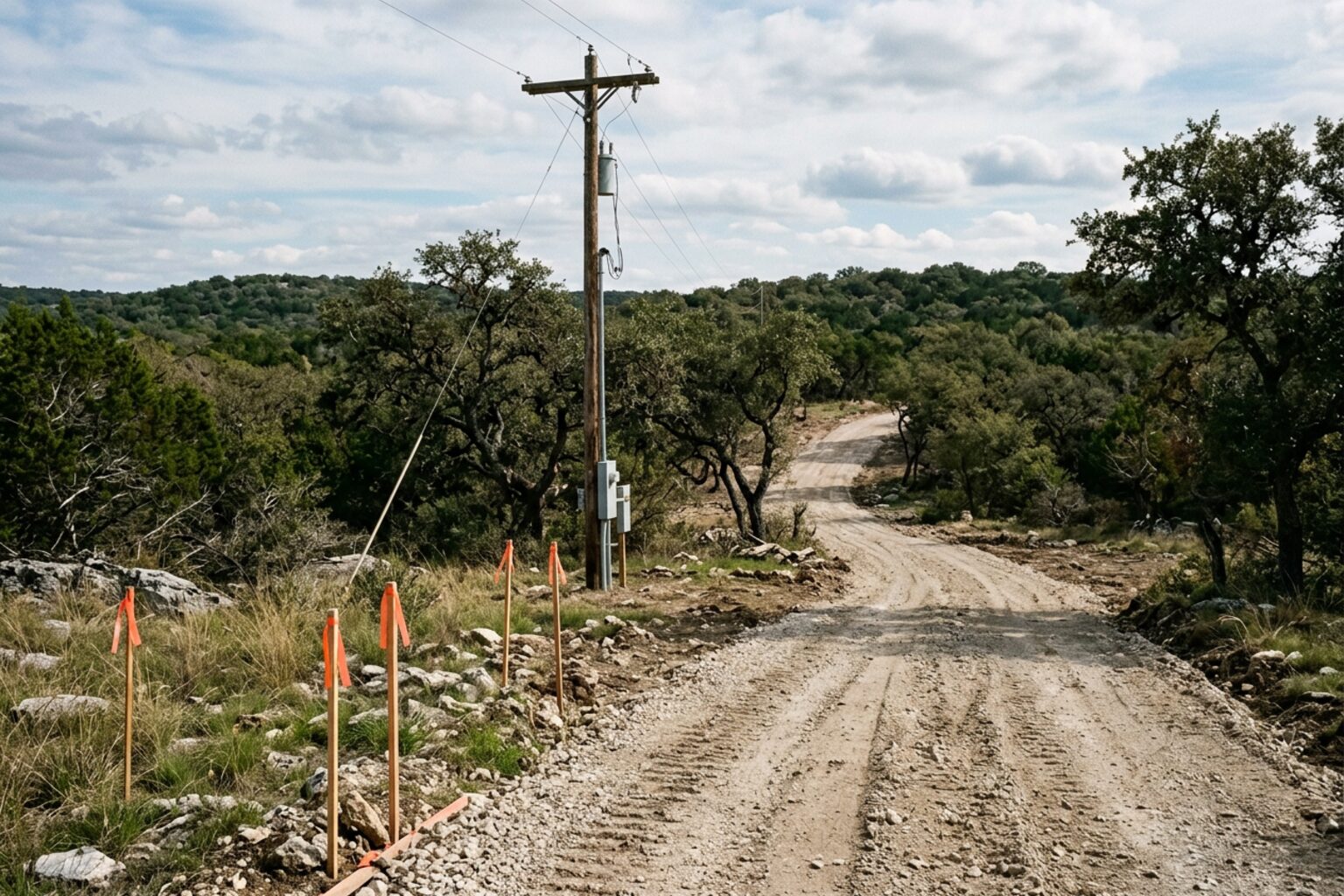
- Electric service: co-op staking, easements, and payment, plus temporary power if needed.
- Driveway and culvert: permitted access that can carry concrete trucks.
- Build: foundation through final, with septic installed and approved along the way.
- Move in: septic license to operate, utilities on, maintenance contract in place.
What should you check before you buy raw land?
Confirm you can legally build, reach the site, and get a septic permit. Some problems cannot be fixed after closing.
- Legal tract: Bastrop County says you must own a legal tract consistent with state law and county subdivision rules before you can get a septic permit. A parcel cut off without platting can stall everything.
- Floodplain: Burnet County charges $25 for a building permit outside the flood hazard area and $400 inside it, and the flood zone permit needs an elevation certificate or engineer’s letter.
- Lot size: TCEQ requires lots of at least 1 acre in subdivisions without a public water system that use septic, per Bastrop County’s summary of the rules.
- Utilities: find out which electric co-op serves the tract and how far the nearest line is. Our guide to the cost to bring electricity to rural land shows how much distance matters.
For the full pre-purchase list, read our guide to buying rural land. If you are still sizing a tract, see how much land you need for a homestead.
Do you need a survey on raw land?
Yes. A boundary survey locates your corners and easements, and your septic setbacks are measured from those lines.
HomeGuide’s land survey cost guide puts a basic boundary survey at $1,000 to $3,000 for 5 acres, $1,500 to $4,000 for 10 acres, and $2,000 to $5,000 for 25 acres. Wooded, hilly, and oddly shaped tracts cost the most per acre. A construction staking survey later costs $400 to $1,800 to mark the house and utilities on the ground.
What is a perc test in Texas, and who does it?
Texas uses a site evaluation rather than a classic perc test. A TCEQ-licensed site evaluator or a professional engineer digs soil profile holes and classifies the soil before any septic system can be designed.
TCEQ says the site must be evaluated by a licensed site evaluator or engineer before an OSSF is built. The LCRA, which permits septic systems around the Highland Lakes, describes the profile hole: usually dug with a backhoe, 2 to 3 feet wide and 2 feet below the planned drain field, with one at each end. If the evaluator finds unsuitable soil, groundwater, or a restrictive layer less than 2 feet below the drain field, a conventional system cannot be used.
Nationally, HomeGuide puts soil and perc testing at $200 to $1,500 with hand-dug holes and $500 to $3,000 or more with an excavator.
How do you get a septic (OSSF) permit in Texas?
You need a permit and an approved plan before you build a septic system, filed with your county or other authorized agent. A designer or engineer prepares the plan from the site evaluation.
That rule comes from 30 Tex. Admin. Code §285.3. The state exempts some single-family systems on 10 or more acres, but counties can be stricter. Bastrop County requires a permit for every septic installation regardless of acreage. Sample county fees:
| County | Standard system permit | Aerobic system permit | Other requirements |
|---|---|---|---|
| Burnet | $250 | $400 | 911 address first, then a building permit before the septic permit |
| Bastrop | $600 | $700 | Floor plans with the application; development permit filed at the same time |
Sources: Burnet County Development Services; Bastrop County 2025 fee schedule and development services page.
Timing matters. LCRA says to allow up to 30 days for permit review, not counting design problems. In Bastrop County, the Permit to Construct lasts one year, so the system must be installed, inspected, and approved within that year. Aerobic systems also need a two-year initial maintenance contract.
Your soil, not your budget, picks the system type. Installation in Central Texas runs $4,500 to $12,700 for conventional and $10,000 to $20,000 for aerobic, per Cornerstone Septic. Our guide to aerobic vs. conventional septic in Texas explains how the site evaluation decides.
Should you drill the well before you build?
Yes. Drill early, because construction needs water, and a dry or low-yield hole may change your plans. Place it on the site plan first so septic setbacks work.
Central Texas builders publish well costs of $18,000 to $25,000 around Waco (KC Construction) and $15,000 to $35,000 in the Hill Country (CMW General Contractors), where depth varies with the geology. LCRA notes that a drain field closer than 100 feet to a well may be allowed depending on how the well was built, so keep the driller’s report.
See the cost to drill a well for depth-based pricing, our guide to well drilling in Texas for permits and aquifers, and our guide to a storage tank for a low-yield well if the yield comes in low.
When should you bring in electric service?
Start the co-op process as soon as the site plan is set, because staking, easements, and construction can take months. Ask for the meter pole where the permanent service will go.
Medina Electric Cooperative publishes sample costs of $3,000 to $7,200 for runs up to about 280 feet. Pedernales Electric’s tariff charges residential applicants the full extension cost and targets completion within 90 days after all requirements are met. Temporary construction power is billed at full cost by every co-op we reviewed. The details are in our guide to the cost to bring electricity to rural land in Texas, and if the line is far away, compare off-grid solar cost.
Do you need a permit for a rural driveway?
Often, yes. Counties regulate connections to county roads, and TxDOT permits connections to state highways. Plan a culvert where the driveway crosses a ditch.
Bastrop County charges a $50 driveway permit, or $75 if the driveway was built without one, and its application asks for a TxDOT permit where one applies. HomeGuide’s gravel driveway guide puts gravel at $4 to $10 per square foot, about $4,000 to $10,000 for a 100-foot by 10-foot drive, with culverts or drains at $500 to $2,000. It recommends 8 to 12 inches of depth for drives that carry trucks, which is what a concrete truck needs.
How long does it take to build after the site work?
Most Central Texas barndominiums take 4 to 8 months from signed contract to move-in, per KC Construction. Permits, rock, and weather cause most delays.
Builders price the structure separately from site work. KC Construction says its per-square-foot price on raw land does not include the well, septic, clearing, driveway, or power. Read our barndominium cost in Texas guide for building prices and our guide to barndominium builders in Central Texas for the build schedule.
How much does it cost to prepare raw land for a home in Texas?
On our estimate, site work runs about $28,000 to $105,000 before the house. The well and the power line make up most of the spread.
| Step | Published range | Source |
|---|---|---|
| Boundary survey, 5 to 10 acres | $1,000–$4,000 | HomeGuide |
| Soil evaluation (perc test, national) | $200–$3,000+ | HomeGuide |
| OSSF permit fee | $250–$700 | Burnet and Bastrop counties |
| Septic system installed | $4,500–$20,000 | Cornerstone Septic |
| Water well | $15,000–$35,000 | KC Construction; CMW |
| Electric service | $3,000–$30,000+ | Medina EC; CMW |
| Gravel driveway, 100 by 10 feet | $4,000–$10,000 | HomeGuide |
| Culvert or drainage | $500–$2,000 | HomeGuide |
| Building and driveway permits | $25–$275 | Burnet and Bastrop counties |
| Total before the house | About $28,000–$105,000 | Our sum of the ranges above |
What is a realistic timeline from closing to move-in?
Plan on roughly 10 to 20 months. Several steps overlap, and the build itself takes the longest.
| Phase | Typical timing | Basis |
|---|---|---|
| Survey and soil evaluation | Months 0–2 | Our estimate; book both before or right after closing |
| Site plan and OSSF design | Months 1–3 | Our estimate |
| OSSF permit review | Up to 30 days after filing | LCRA |
| Well drilled and pump set | Months 2–4 | Our estimate; driller schedules vary |
| Electric service | Up to 90 days after requirements are met | PEC tariff |
| Driveway and building pad | Months 3–5 | Our estimate |
| Construction, including septic install | 4–8 months | KC Construction |
| Septic must be installed and approved | Within 1 year of the permit | Bastrop County |
Decision rule: do not sign a build contract until you have a site evaluation, an approved or near-approved OSSF design, and a working well. Those three facts can change your house location, your septic budget by $10,000 or more, and whether the tract works at all.
Get a free local quote
Ready to start on raw land in Texas? Tell us your county, your acreage, and which steps you still need, whether that’s a well, a septic system, or a builder, and we’ll pass your request to local contractors who serve your county.
Bottom line: Survey, soil evaluation, septic permit, well, power, driveway, then build. Budget about $28,000 to $105,000 for site work before the house and 10 to 20 months from closing to move-in. Lock in the soil evaluation and the well before you commit to a house plan, because they decide where and whether you can build.
Frequently asked questions
What comes first when building on raw land in Texas?
A boundary survey and a soil evaluation by a TCEQ-licensed site evaluator. The survey sets property lines for setbacks, and the soil evaluation decides which septic system the land can take. Counties want the well, septic, power, and driveway on one site plan, so these come before design.
How much does a perc test cost in Texas?
Texas uses a site evaluation with soil profile holes rather than a classic perc test. HomeGuide puts soil and perc testing at $200 to $1,500 with hand-dug holes and $500 to $3,000 or more with an excavator, nationally. Ask installers whether the evaluation is included in their septic quote.
Do I need a septic permit on 10 acres in Texas?
It depends on the county. State rules exempt some single-family systems on 10 or more acres if the system meets all design standards and sits 100 feet from property lines. Counties can be stricter: Bastrop County requires a permit for every septic installation regardless of acreage.
Should I drill a well or put in septic first?
Plan them together, then drill the well first. Septic drain fields must keep set distances from wells, so both belong on the same site plan. Drilling early gives you water for construction and tells you whether the yield is enough before you commit to a house plan.
How long does it take to build a house on raw land in Texas?
On our estimate, 10 to 20 months from closing to move-in. Survey, soil work, permits, well, and power often take 4 to 8 months, and Central Texas barndominium builders quote 4 to 8 months of construction. LCRA allows up to 30 days for septic permit review.
Updated October 2026. Costs are published ranges from the sources linked, not quotes. Totals and timelines that combine them are our estimates. County rules vary, so confirm with your county’s development services office.