Is a Harvest Right Freeze Dryer Worth It? Cost Per Batch, Per Year, and Payback (2026)
Yes, if it replaces store-bought freeze-dried food. A Medium runs about $11 a batch, makes $2.94 servings vs $6.15 retail, and pays back in about 30 batches.
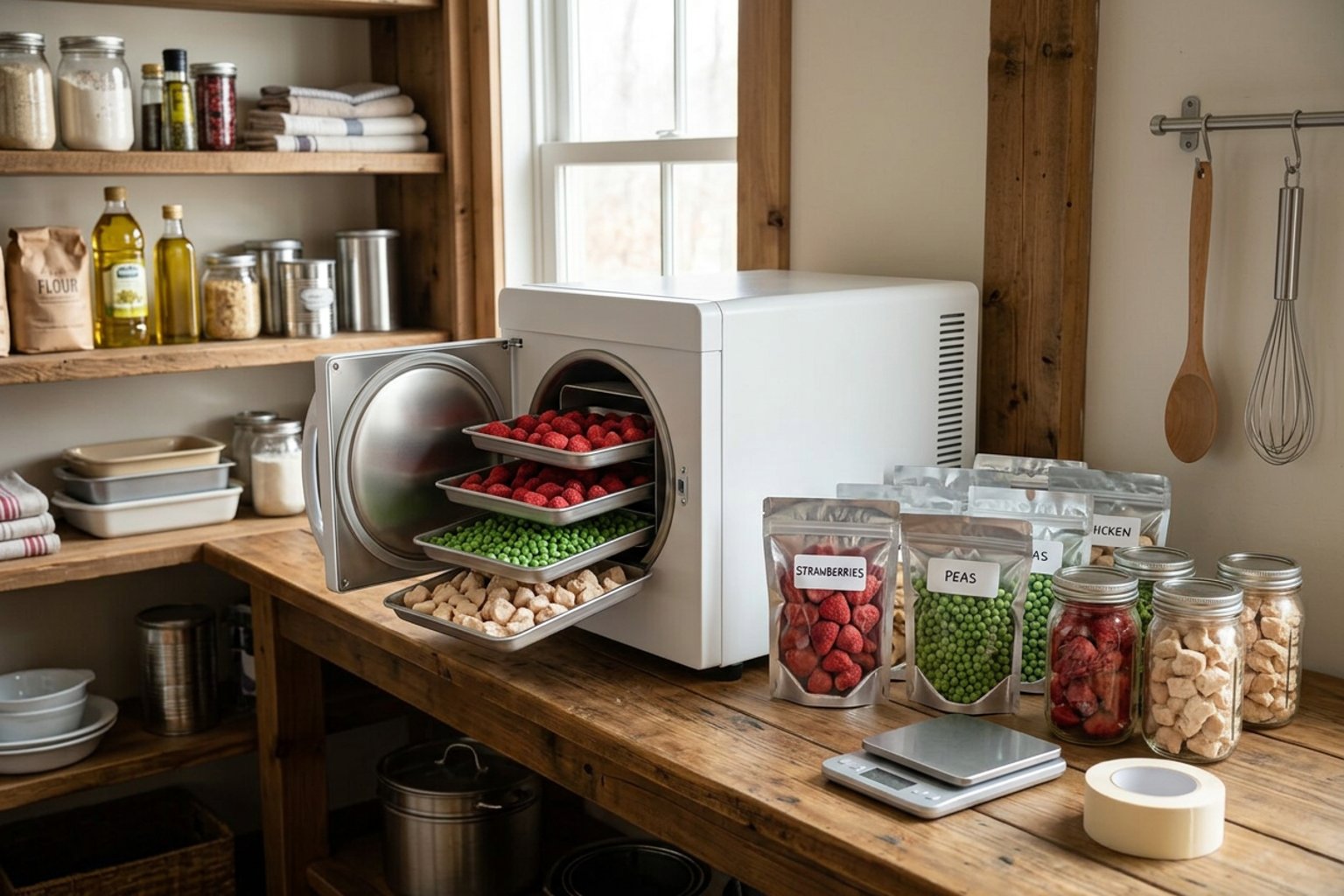
Short answer: Is a Harvest Right freeze dryer worth it? Yes, if you would otherwise buy freeze-dried food. On our model, a Medium costs about $11 a batch to run and turns out 25 servings at roughly $2.94 each, against $6.15 retail. That pays back the $2,395 machine in about 30 full batches.
Updated October 2026 · By Paul Michael. Prices were read from harvestright.com and mountainhouse.com on October 19, 2026. Electricity rates are from the U.S. Energy Information Administration. Per-batch and payback figures are our calculations from those numbers, not bench tests.
Disclosure: some links on this page are affiliate links. If you buy through them, Offsprig may earn a commission at no extra cost to you. It does not change what we recommend.
A freeze dryer is one of the priciest tools a homesteader can buy, and one of the few that can pay for itself in a year. This guide builds the cost per batch from Harvest Right’s own specs, current U.S. and Texas power rates, and real prices for oil, Mylar bags, and oxygen absorbers. Then it runs payback at four usage levels.
To see where it fits in your budget, check what it costs to start a homestead.
How much does a Harvest Right freeze dryer cost in 2026?
As of October 19, 2026, the Harvest Right Home Freeze Dryer runs $1,895 (Small) to $4,995 (X-Large) during a sitewide sale. Regular prices are $600 to $900 higher on the three smaller sizes. The pump, trays, an impulse sealer, and a starter pack of 50 Mylar bags and 50 oxygen absorbers come in the box.

| Model (lowest-price color) | Sale price, Oct 19, 2026 | Regular price | Fresh food per batch | Trays / tray area | Power |
|---|---|---|---|---|---|
| Countertop 360 | $1,295 | No sale listed | 5 to 9 lb | 4 / 358 sq in | 110V, built-in pump |
| Small (black) | $1,895 | $2,495 | 6 to 10 lb | 4 / 434 sq in | 110V, dedicated 15A circuit |
| Medium (black or white) | $2,395 | $3,195 | 10 to 15 lb | 5 / 675 sq in | 110V, dedicated 15A circuit |
| Large (black or white) | $2,995 | $3,895 | 18 to 27 lb | 6 / 1,107 sq in | 110V NEMA 5-15, dedicated 15A |
| X-Large (stainless only) | $4,995 | $5,295 | 40 to 50 lb | 7 / 2,251 sq in | 110V NEMA 5-20, dedicated 20A |
Sources: the Harvest Right Home Freeze Dryer product page and its FAQ. Stainless versions cost $400 to $500 more. Sale prices change often, so check before you buy.

What is the difference between Harvest Right Pro and Home?
In 2026 they are the same machine. Harvest Right sells one home line, called the Home Freeze Dryer, and its in-box list still names each unit a “Pro” (for example, “Medium Pro Freeze Dryer”). All four sizes ship with a Premier oil pump.
The label matters for used machines. Harvest Right’s Wi-Fi Upgrade Kit page says only Pro units can take Wi-Fi and the version 6 software, and you can spot one by shelf count: 4 on a Small, 5 on a Medium, 6 on a Large, 7 on an X-Large. The Pharmaceutical and Scientific models are lab machines, not food dryers.
How much does it cost to run a Harvest Right per batch?
On our model, a Medium costs about $11.10 per full batch at the U.S. average power rate, or $10.45 in Texas: about $4.83 in power, $5.62 in packaging, and $0.64 in oil. On larger machines, packaging costs more than power.
How each piece is built:
- Electricity. Harvest Right’s FAQ lists average draw at 990 to 1,210 watts for the Small and Medium, about 1,500 watts for the Large, and about 1,700 watts for the X-Large. It says most foods take 13 to 35 hours. We used 24 hours at the midpoint wattage: 26.4 kWh for a Small or Medium, 36 kWh for a Large, and 40.8 kWh for an X-Large. We priced that at EIA’s July 2026 average residential rate: 18.31 cents per kWh nationally and 15.88 cents in Texas.
- Pump oil. Harvest Right says to change Premier pump oil every 20 to 30 batches. A bottle of Harvest Right vacuum pump oil is $15.98. We assumed one bottle per change every 25 batches, or $0.64 a batch. The included filter lets you reuse oil, so this runs high.
- Bags and oxygen absorbers. A 50-pack of 8″ x 12″ Mylar bags is $24.99 and a 50-pack of oxygen absorbers is $19.99, so about $0.90 per sealed bag. We assumed four servings per bag.
- Servings per batch. We assumed a 1-cup serving is about half a pound of fresh food, at the middle of each batch range: 16 servings (Small), 25 (Medium), 45 (Large), and 90 (X-Large).
| Model | kWh per batch | Power, U.S. avg / Texas | Oil | Bags + absorbers | Total per batch (U.S.) | Running cost per serving |
|---|---|---|---|---|---|---|
| Small | 26.4 | $4.83 / $4.19 | $0.64 | $3.60 | $9.07 | $0.57 |
| Medium | 26.4 | $4.83 / $4.19 | $0.64 | $5.62 | $11.10 | $0.44 |
| Large | 36.0 | $6.59 / $5.72 | $0.64 | $10.12 | $17.35 | $0.39 |
| X-Large | 40.8 | $7.47 / $6.48 | $0.64 | $20.24 | $28.35 | $0.32 |
Food is not included. Cost per serving falls as the machine gets bigger, because power and oil are spread over more food.
Why is our electricity number higher than Harvest Right’s?
Harvest Right’s FAQ estimates $1.25 to $2.80 in power per batch for the Small and Medium. At the July 2026 U.S. rate, that implies only about 7 to 15 kWh. Our 26.4 kWh assumes the listed average draw for a full 24 hours, so treat it as cautious. Harvest Right’s own electricity guide now says no single number fits every batch and suggests metering your own. A plug-in kWh meter on your first few batches will tell you where you land.
How much does a freeze dryer cost per year?
Running costs are modest next to the purchase price. A Medium run twice a month costs about $266 a year in power, oil, and packaging at the U.S. rate. Run it every week and that rises to about $533.
| Model | 1 batch/month | 2 batches/month | 1 batch/week (4/month) | 2 batches/week (8/month) |
|---|---|---|---|---|
| Small | $109 | $218 | $435 | $871 |
| Medium | $133 | $266 | $533 | $1,065 |
| Large | $208 | $416 | $833 | $1,666 |
| X-Large | $340 | $680 | $1,361 | $2,722 |
Yearly running cost at 18.31 cents per kWh, food not included. In Texas, subtract about $0.64 to $0.99 per batch for the lower power rate.
How long does a Harvest Right take to pay for itself?
On full batches that replace store-bought freeze-dried food, a Medium pays back in about 30 batches, a Large in about 20, and an X-Large in about 17. At two batches a month, that is about 15 months for a Medium.
We assumed $2.50 of ingredients per serving of a home-cooked meat-and-noodle dish, roughly a quarter pound of ground beef at the BLS September 2026 average of $6.79 per pound plus noodles, dairy, and vegetables. Add the running cost and a home Medium serving costs about $2.94. The retail benchmark is $6.15 a serving, from Mountain House Beef Stroganoff in a #10 can ($61.49 for 10 servings). That saves about $3.21 a serving, or about $80 per full Medium batch.
| Model (sale price) | Savings per full batch | Batches to pay back | 1 batch/month | 2 batches/month | 1 batch/week | 2 batches/week |
|---|---|---|---|---|---|---|
| Small ($1,895) | $49 | 38 | 38 months | 19 months | 10 months | 5 months |
| Medium ($2,395) | $80 | 30 | 30 months | 15 months | 7.5 months | 3.7 months |
| Large ($2,995) | $147 | 20 | 20 months | 10 months | 5 months | 2.5 months |
| X-Large ($4,995) | $300 | 17 | 17 months | 8 months | 4 months | 2 months |
Our calculation at the U.S. power rate. At regular (non-sale) prices, add about a third to the Small, Medium, and Large payback times.
The decision rule: savings only count for food you would really have bought freeze-dried. If only half of what you dry replaces store-bought meals, and the rest is snacks or leftovers you would have eaten anyway, payback doubles. A Medium then needs about 60 full batches. If you would never buy freeze-dried food at all, the machine is a convenience and storage tool, not a money saver.
Is freeze drying at home cheaper than buying freeze-dried food?
Yes, by about half per serving, before you count the machine. Retail prices we checked ran $5.57 to $6.25 a serving. Our modeled home cost is $2.80 to $3.07.
| Product | Price (Oct 19, 2026) | Servings | Cost per serving |
|---|---|---|---|
| Mountain House Beef Stroganoff, pouch | $12.49 | 2 | $6.25 |
| Mountain House Beef Stroganoff, #10 can | $61.49 | 10 | $6.15 |
| Mountain House Diced Chicken, #10 can | $77.99 | 14 | $5.57 |
| Home freeze-dried meal, Medium (our model) | About $11.10 to run, plus food | 25 | About $2.94 |
Retail prices and serving counts from mountainhouse.com. Home cost assumes $2.50 of ingredients per serving. Garden produce or leftovers that would otherwise spoil bring it lower.
How does freeze drying compare with canning and dehydrating?
Freeze drying keeps food far longer and handles whole meals, but it is slower and costs much more up front. Canning and dehydrating stay the cheaper choices for food you will eat within a year.
| Factor | Freeze drying | Pressure or water-bath canning | Dehydrating |
|---|---|---|---|
| Best-quality storage | Up to 25 years in Mylar or #10 cans with oxygen absorbers, for some foods | Can no more than you will use within a year | 4 months to 1 year; vegetables keep about half as long as fruit |
| Heat-sensitive vitamins | Keeps as much as 97% | Can lose up to 60% | Can lose up to 40% |
| Process time | 20 to 40 hours a batch | Set by tested recipe | 4 to 16 hours |
| What works | Raw and cooked foods, full meals, some dairy; high-fat foods are hard | Tested recipes only | Mainly fruits, vegetables, meats |
Sources: University of Arizona Cooperative Extension, Basics of Home Freeze Drying (2025); National Center for Home Food Preservation on storing canned foods and storing dried foods.
For most homesteads the answer is both. Can and dehydrate what you will eat this year. Save freeze-dryer time for meals, meat, and long-term storage. Our first-year homesteading plan covers which preserving skills to learn first.
Can you run a freeze dryer off-grid or on backup power?
You can, but it is a big load. On our 26.4 kWh estimate, one Medium batch a day would need roughly 6.6 kW of solar panels at 5 sun-hours, after about 20% system losses. A portable power station will not carry a full cycle.
For sizing logic, see our guides to what an off-grid solar system costs and running a well pump from a power station. Watch heat too. Harvest Right lists 50 to 75°F as ideal and says running above 105°F voids the warranty, which rules out many Texas garages in summer.
Who should not buy a freeze dryer?
Skip it, or wait, if any of these fit you:
- You rarely buy freeze-dried or backpacking meals, so there is little spending to replace.
- You would run fewer than about 12 full batches a year. A Medium then takes about two and a half years to pay back, a Small more than three.
- You have no spot with a dedicated circuit, airflow, and a room that stays under about 80°F.
- Most of your harvest gets eaten within a year, so canning and freezing already do the job.
One more trade-off: the oil-free pump is a $1,495 upgrade at purchase. It ends oil changes, but at about $0.64 a batch in oil, it would take more than 2,000 batches to recover in savings. Buy it for convenience, not payback.
Bottom line: A Harvest Right freeze dryer is worth it if it replaces food you would otherwise buy freeze-dried, and you will run it at least twice a month. On our model, home servings cost about $2.80 to $3.07 against $5.57 to $6.25 retail. A Medium at $2,395 pays back in about 30 full batches, a Large in about 20. Power runs about $4 to $7.50 a batch depending on size and state, and packaging is the bigger running cost on large machines. If you would only dry a few batches a year, or would never buy freeze-dried food, put the money into a pressure canner, a dehydrator, and freezer space instead.
Frequently asked questions
How much electricity does a Harvest Right use per batch?
Harvest Right lists average draw of 990 to 1,210 watts for the Small and Medium, about 1,500 for the Large, and 1,700 for the X-Large. Over a 24-hour cycle, that is about 26 to 41 kWh. Harvest Right’s own cost estimates imply less, so meter your machine to know.
How many batches until a Harvest Right pays for itself?
On our model, about 38 full batches for a Small, 30 for a Medium, 20 for a Large, and 17 for an X-Large at October 2026 sale prices. That assumes every serving replaces a $6.15 store-bought freeze-dried serving. If only half does, double those numbers.
What size Harvest Right should I buy?
Buy for the batches you will really fill. Harvest Right rates the Medium at 10 to 15 pounds of fresh food per batch and the Large at 18 to 27. The Large has the lowest cost per serving among 15-amp models, but half-empty batches erase that advantage.
Is the Harvest Right oil-free pump worth it?
Only for convenience. The oil-free pump is a $1,495 upgrade at purchase and removes oil changes every 20 to 30 batches. With oil at about $0.64 a batch on our math, it would take more than 2,000 batches to pay for itself in oil savings alone.
How long does home freeze-dried food last?
Some freeze-dried foods can last up to 25 years when sealed in Mylar bags or #10 cans with oxygen absorbers, according to University of Arizona Extension. Keep them airtight, dark, and below 60°F for best quality. Food stored above 80 to 90°F loses quality much faster.