Hand Pump for Well Backup: Drop-Pipe vs Side-by-Side, Depth Limits, and Costs
Pitcher pumps reach 25 ft, inline pumps 160 ft, side-by-side pumps 250 to 325 ft of static water. Parts start near $1,980. Which fits your Texas well.
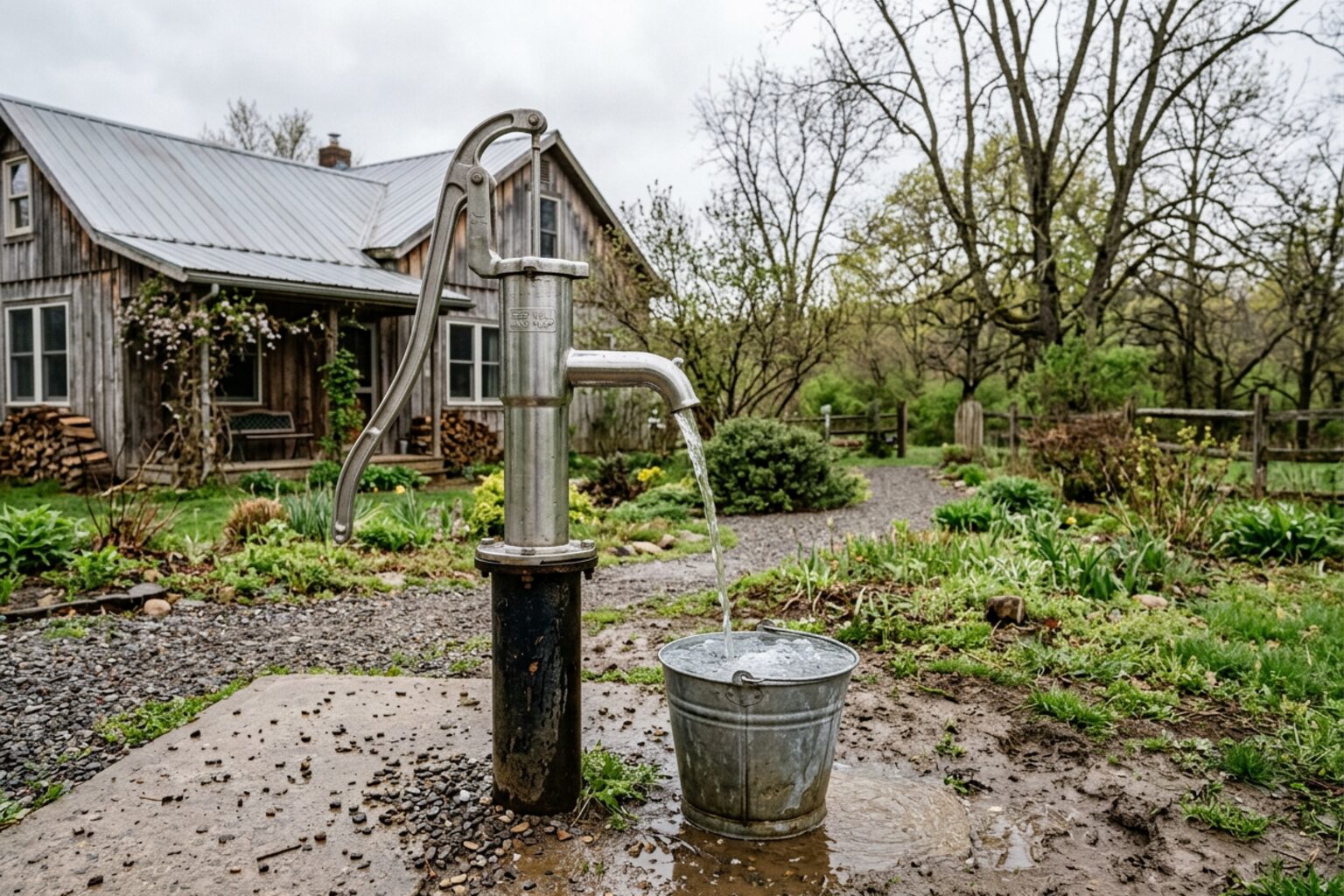
Short answer: A hand pump for well backup works if your static water level is within reach: about 25 feet for a surface pitcher pump, 160 feet for an inline (stacked) pump, and 250 to 325 feet for a side-by-side deep well pump. Parts start around $1,980 for a 50-foot system, as of October 2026, and deeper wells cost more.
Texas has a recent reason to care. After Winter Storm Uri in February 2021, a University of Houston Hobby School survey found that 69% of Texans lost power for an average of 42 hours, and 49% lost running water for an average of more than two days. A submersible pump does nothing without power. A hand pump keeps working.
How deep can a hand pump pull water from a well?
It depends on the pump type. A surface pitcher pump lifts about 25 feet at sea level. Deep well hand pumps put a cylinder down in the water and lift from 110 to 325 feet of static water level, depending on cylinder size.
| Pump type | Max static water level | Output per stroke | Spec source |
|---|---|---|---|
| Surface pitcher / suction pump | 25 ft at sea level (minus 1 ft per 1,000 ft of elevation) | About 19 oz (Bison Model 1900) | Simple Pump specs, Bison FAQ |
| Inline (stacked) deep well pump | 160 ft | About 12 oz (2.5 in. cylinder) | Bison Inline-Top |
| Side-by-side stainless pump, standard handle | 250 ft | 4 to 20 oz (1.5 to 3.0 in. cylinder) | Bison Standard |
| Side-by-side stainless pump, heavy-duty head | 300 ft | Varies by cylinder | Bison Standard |
| Modular aluminum-head pump, small cylinder (100CA) | 325 ft | 4.5 oz | Simple Pump specs |
| Modular aluminum-head pump, mid cylinder (125CA) | 225 ft | 8.5 oz | Simple Pump specs |
| Modular aluminum-head pump, large cylinder (200CA) | 110 ft | 20 oz | Simple Pump specs |
The pattern in that table is physics. Bison’s FAQ says you lift about half a pound of water for every foot of depth, so deeper wells get smaller cylinders and less water per stroke.
Is static water level the same as well depth?
No. Static water level is the distance from the ground to the water at rest in the well, not the total depth, and it is the number that decides which hand pump fits. Simple Pump’s pricing page makes this point, and says your well report or driller can give it to you.
This matters in the Texas Hill Country, where total depths are large. Hill Country Well and Pump puts residential well depths at about 250 to nearly 1,000 feet across Gillespie, Kendall, Burnet, Blanco, Hays, and Kerr counties, with Fredericksburg-area Hickory wells often 500 to 800 feet deep. A deep well can still have a static level that a hand pump reaches, but you need the measurement, not the drill depth. Our Gillespie County well drilling page covers local depths.
What is the difference between a drop-pipe (inline) and side-by-side hand pump?
A side-by-side pump runs its own drop pipe and cylinder down the casing next to your submersible pump. An inline (stacked) pump sits on top of the submersible and shares its line. Side-by-side needs more casing room. Inline needs the submersible pulled to install.
| Feature | Side-by-side (own drop pipe) | Inline / stacked (shares the line) |
|---|---|---|
| Casing with a submersible | 5 in. outside diameter or more, water exiting through a pitless adapter (Bison) | 4 in. or less, or 5 in.+ with a liner; cylinder cage about 3 in. wide sets the minimum (Bison) |
| Max static water level | 250 ft standard, 300 ft heavy-duty (Bison); up to 325 ft (Simple Pump 100CA) | 160 ft (Bison) |
| Freeze-proof | Yes, with a weep hole drilled below the frost line (Bison) | No (Bison) |
| Water into the house | With an add-on pressurizing kit | Through the existing water line |
| Installation | Two handy people for most systems; mechanical lifting past nine 8-ft sections (Bison) | Requires pulling the submersible; professional with lifting equipment recommended (Bison) |
| Drop pipe | 1 in. or 1-1/4 in. Schedule 120 PVC (Bison); 1 in. Schedule 80 PVC (Simple Pump) | Typically 1-1/4 in. Schedule 120 PVC (Bison) |
Most details in that table come from Bison’s Standard and Inline-Top product pages. Bison recommends 1-inch drop pipe where casing space is tight or the static level is deeper than 160 feet, and ships enough pipe to put the cylinder about 20 feet below static level to allow for a falling water table.
Simple Pump lists casing compatibility from 2 inches through 8 inches and up, and says it installs alongside an electric pump. Its pricing page adds that installing next to an existing submersible may need extra components and a custom quote. It also sells an inline dual-pump valve assembly for pairing the hand pump with a solar submersible.
Which hand pump fits my well? (Decision rule)
Match the pump to your static water level first, then your casing size. This is our decision rule built from the manufacturer limits above:
- Static level 25 ft or less (at sea level, less at elevation): a surface pitcher or suction pump is the cheapest option.
- Static level up to 160 ft, 4-inch casing, submersible in place: an inline (stacked) pump is usually the only design that fits. Budget for a pro to pull the submersible, and protect it from freezing.
- Static level up to 250 to 325 ft, 5-inch or larger casing: a side-by-side deep well pump. Pick the cylinder from the maker’s chart for your depth.
- Static level deeper than 325 ft: no hand pump on this list reaches it. Look at a generator for your well pump or a power station instead.
How much water can you hand pump in an outage? (Worked example)
Enough for drinking and basic sanitation in a few minutes a day. Ready.gov recommends at least one gallon per person per day for drinking and sanitation, and says needs can double in very hot weather.
Ready.gov’s water guidance gives the daily figure. Here is our worked example for a family of four over a three-day outage (12 gallons), using each maker’s published strokes per gallon and an assumed pace of 15 strokes a minute:
| Cylinder | Strokes per gallon | Strokes for 12 gal | Time at 15 strokes/min |
|---|---|---|---|
| Small (100CA, for depths to 325 ft) | 28.4 | 341 | About 23 minutes |
| Mid (125CA, to 225 ft) | 15.1 | 181 | About 12 minutes |
| Large (200CA, to 110 ft) | 6.4 | 77 | About 5 minutes |
| 3 in. stainless cylinder (20 oz per stroke) | 6.4 (our calc: 128 oz ÷ 20) | 77 | About 5 minutes |
Strokes per gallon for the first three rows come from the Simple Pump specs. The 15 strokes a minute is an assumption for planning. Deep-well pumping is harder work, so a slower pace is realistic on deep wells. In heat, Ready.gov says double the water.
Can a hand pump pressurize the house plumbing?
Yes, with the right setup. Simple Pump lists up to 45 psi typical output. Bison sells a pressurizing kit that connects the pump outlet to the pressure tank drain valve, and its inline pump pushes water through the existing house line.
Bison lists its pressurizing kit at $198. With pressure in the tank, you can flush toilets and run a sink from the house plumbing without carrying buckets. Each pump stroke only moves a few ounces, so filling a pressure tank takes steady work.
How much does a hand pump for well backup cost?
Expect about $2,000 and up for a deep well system’s parts at a 50-foot static level, plus shipping. Deeper wells cost more because they need more pipe and rod, and both makers price by quote.
| Item | Published price | Source |
|---|---|---|
| Modular deep well hand pump system, 50 ft static level | From $1,980 (parts only) | Simple Pump |
| Shipping for that system | $170 to $310 | Simple Pump pricing |
| Seal kits (wear parts) | $32 to $41 | Simple Pump |
| Stainless side-by-side system | By quote; Bison says a fixed price cannot be given because each well differs | Bison |
| Heavy-duty pump head option (to 300 ft) | $352 | Bison |
| Pressurizing kit | $198 | Bison |
| Stainless silt screen for sandy wells | $341 | Bison |
| Cylinder maintenance kits | About $93 to $127 | Bison |
Simple Pump lists a typical maintenance interval of 5 to 10 years between seal replacements. Both makers advertise a lifetime warranty on non-wear parts. Professional installation is extra and varies, and is most likely on an inline install, where the submersible has to come out.
For context, a hand pump costs less than many whole-house generator setups, but it does less. It gives you water, not power. If you are already pricing a new submersible, our well pump replacement cost guide shows when it makes sense to add the hand pump during the same service call.
Can I install a well hand pump myself in Texas?
Often, yes, on your own property. Texas law exempts a person installing or repairing well pumps on their own property for their own use from the pump installer definition, so no installer license is needed for that work.
That exemption is in Texas Occupations Code §1902.001. Bison says most of its side-by-side systems can be installed by two handy people, and recommends mechanical lifting once the system runs past nine 8-foot pipe sections, which is about 72 feet. Keep the well sealed while you work. Bison’s FAQ notes that leaving the vent opening uncapped exposes the well to contamination, and it explains how to chlorinate a well through the pump’s well cap plug.
Hire a licensed pump installer if you have to pull the submersible, if your static level is deep, or if you are not sure your casing has room. Our Texas well drilling hub lists what to ask a contractor.
Will a hand pump freeze in a Texas winter?
A side-by-side deep well pump can be freeze-proof. Bison’s design drains the pump head back into the well through a small weep hole drilled below the frost line. Inline pumps and surface pitcher pumps can freeze.
Bison says its inline pump is not freeze-proof, and that its pitcher pump needs a drain-back feature where freezing is possible. Uri showed that a hard freeze can hit the whole state, so pick a freeze-proof design if you can, or plan to drain the pump before a freeze.
A hand pump also pairs well with stored water. If your well is slow to recover, a storage tank filled by hand or by the electric pump stretches your supply. See our guide to a storage tank for a low-yield well.
Bottom line: Get your static water level from your well report before you shop. Within 25 feet, a pitcher pump works. Up to 160 feet in a tight 4-inch casing, an inline pump is the fit. Up to 250 to 325 feet with a 5-inch or larger casing, a side-by-side pump gives freeze-proof backup. Budget about $2,000 and up for parts, and more for deeper wells.
Get a free local quote
Want help sizing and installing one? Tell us your county, static water level, casing size, and whether a submersible is already in the well, and we will pass your request to pump installers who serve your area.
Frequently asked questions
Can you put a hand pump on a well that already has a submersible pump?
Yes. A side-by-side pump runs its own pipe next to the submersible, and Bison requires a casing of at least 5 inches outside diameter for that. In a 4-inch casing, an inline pump sits on top of the submersible instead, but installing it means pulling the submersible, and Bison rates it to 160 feet.
How deep can a hand pump lift water?
A surface pitcher pump lifts about 25 feet at sea level, losing about a foot per 1,000 feet of elevation. Deep well hand pumps reach farther: Bison lists 250 feet with its standard handle and 300 feet with a heavy-duty head, and Simple Pump lists 325 feet with its smallest cylinder.
How much does a well hand pump cost?
Simple Pump lists its deep well system from $1,980 in parts for a 50-foot static water level, plus $170 to $310 shipping. Deeper wells need more pipe and rod, so the price rises with depth. Bison prices each system by quote. Professional installation, if you need it, is extra.
Do I need a license to install a hand pump on my well in Texas?
Not on your own property for your own use. Texas Occupations Code §1902.001 excludes a person who installs or repairs well pumps on their own property for their own use from the definition of a pump installer. Hire a licensed installer for anyone else’s well, or when the submersible must come out.
How long does it take to hand pump a gallon of water?
It depends on the cylinder. A small deep-well cylinder takes about 28 strokes per gallon, roughly two minutes at 15 strokes a minute, by our math from Simple Pump specs. A large cylinder takes about 6 strokes per gallon. Larger cylinders only work at shallower static water levels.
Updated October 2026. Depth limits, outputs, and prices come from manufacturer spec pages for two common designs, linked in this guide. We have not installed or tested either one. Worked examples are our own math from those specs.