How Deep Are Water Wells in Texas? County-by-County Data (2026)
How deep are water wells in Texas? State driller reports for 59,866 new household wells in 48 counties: median depth by county, cost ranges, gypsum hotspots, and a free dataset.
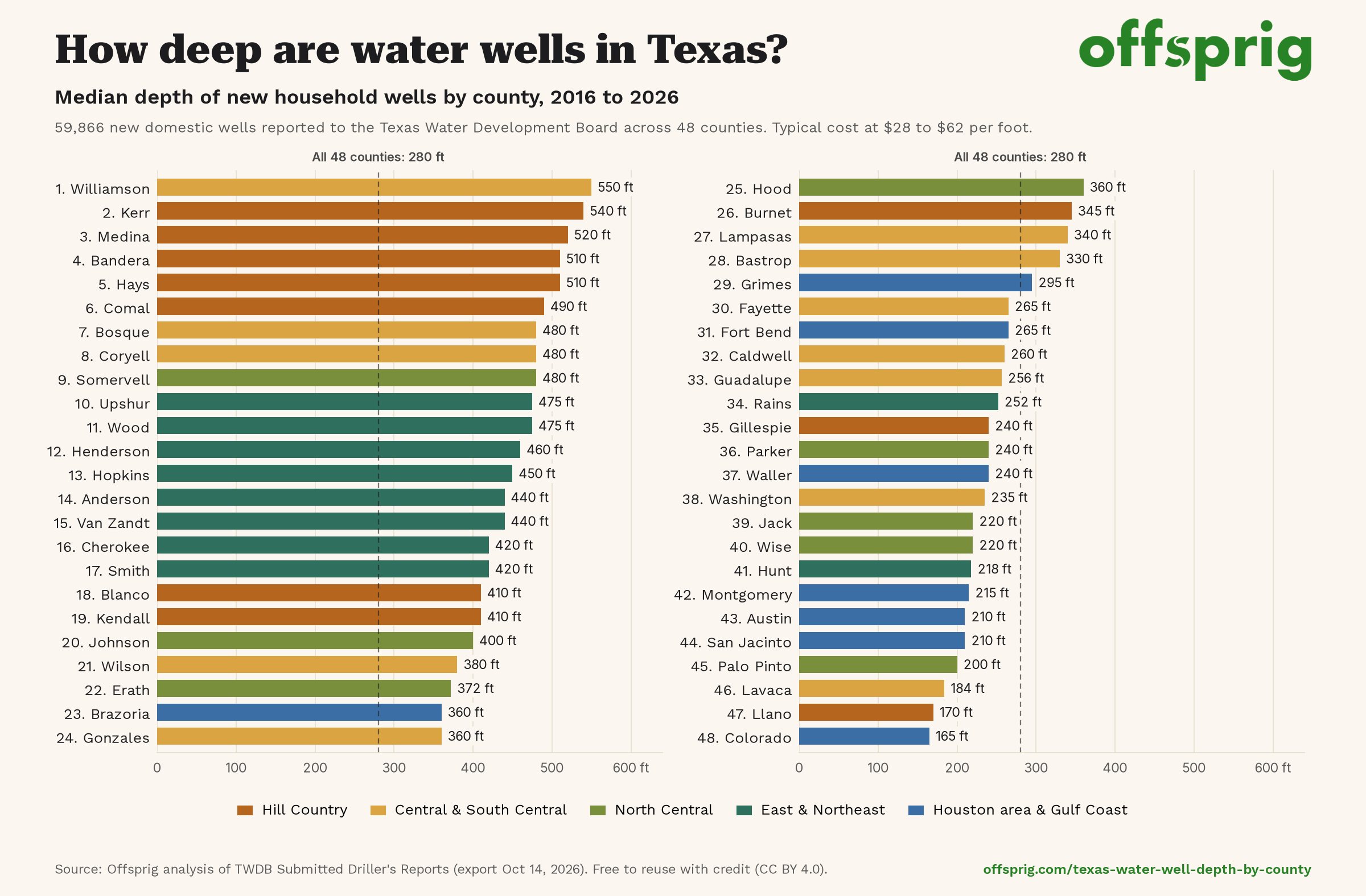
How deep are water wells in Texas? Across 59,866 new household wells that drillers reported to the state from 2016 to October 2026 in 48 Texas counties, the median well was 280 feet deep. County medians run from 165 feet in Colorado County to 550 feet in Williamson County, so a complete well can cost about $4,600 or more than $34,000.
We built this from the state’s own well records: every new domestic well report filed in the Texas Water Development Board (TWDB) Submitted Driller’s Report database for the 48 counties where Offsprig has a local well page. Below are the headline findings, a sortable table for every county, how we did it, and the limits. You are welcome to use the data with credit.
What are the key findings?
Depth, and with it cost, depends far more on the county than on any statewide average. Five findings stand out.
- Deepest wells: Williamson County has the deepest median new household well at 550 feet, followed by Kerr County (540 ft), Medina County (520 ft), and Bandera County and Hays County (510 ft each).
- Shallowest wells: Colorado County (165 ft), Llano County (170 ft), and Lavaca County (184 ft) have the shallowest medians. A typical Williamson County well is more than three times as deep as a typical Colorado County well, which works out to about $15,400 to $34,100 versus $4,600 to $10,200 at Angi’s $28 to $62 per foot Texas range.
- Least predictable depth: in Medina County, the middle half of new wells runs from 320 to 810 feet, a 490-foot spread, the widest of the 48 counties. A 320-foot well there is about $9,000 to $19,800; an 810-foot well is about $22,700 to $50,200. Bosque County (240 to 700 ft) and Anderson County (220 to 640 ft) come next.
- Gypsum hotspots: drillers flagged injurious water on 26.4% of new household well reports in Bandera County (279 of 1,055), 18.4% in Medina County (152 of 825), and 8.4% in Kerr County (80 of 950). Gypsum was the constituent named in nearly all of those entries. No other county topped 2%.
- East Texas drills deep too: pooled across all wells, the 10 East and Northeast Texas counties had a median of 430 feet, deeper than the 10 Hill Country counties at 400 feet. The Houston-area and North Central counties both came in at 240 feet.
One more pattern: new household well reports across these 48 counties climbed from 4,443 in 2016 to a peak of 7,783 in 2022, up 75%, then eased to 5,380 in 2025. Parker County alone filed 7,499 reports since 2016, about twice as many as any other county here.
How deep are wells in each part of Texas?
East Texas and the Hill Country have the deepest wells; the Houston area and the counties west of Fort Worth have the shallowest. These are medians of every well in each group, so busy counties weigh more.
| Region (counties in our data) | Median depth | Wells with a reported depth |
|---|---|---|
| East & Northeast (Anderson, Cherokee, Henderson, Hopkins, Hunt, Rains, Smith, Upshur, Van Zandt, Wood) | 430 ft | 3,620 |
| Hill Country (Bandera, Blanco, Burnet, Comal, Gillespie, Hays, Kendall, Kerr, Llano, Medina) | 400 ft | 13,889 |
| Central & South Central (Bastrop, Bosque, Caldwell, Coryell, Fayette, Gonzales, Guadalupe, Lampasas, Lavaca, Washington, Williamson, Wilson) | 300 ft | 10,707 |
| North Central (Erath, Hood, Jack, Johnson, Palo Pinto, Parker, Somervell, Wise) | 240 ft | 16,631 |
| Houston area & Gulf Coast (Austin, Brazoria, Colorado, Fort Bend, Grimes, Montgomery, San Jacinto, Waller) | 240 ft | 15,019 |
How deep are water wells in every county we cover?
Tap a column heading to sort. Cost is our estimate at the median depth using Angi’s 2026 Texas range of $28 to $62 per foot, not a quote. “Injurious water” is the share of reports where the driller said the well passed through a layer with harmful constituents. Counties with fewer than 150 reports are marked with an asterisk, so treat them with care.
| 1 | Williamson | Central & South Central | 550 | 470 to 700 | $15,400 to $34,100 | 1,272 | 0.2% | Trinity, Edwards (BFZ) |
| 2 | Kerr | Hill Country | 540 | 375 to 660 | $15,100 to $33,500 | 950 | 8.4% | Trinity |
| 3 | Medina | Hill Country | 520 | 320 to 810 | $14,600 to $32,200 | 825 | 18.4% | Edwards (BFZ), Trinity, Carrizo-Wilcox |
| 4 | Bandera | Hill Country | 510 | 450 to 640 | $14,300 to $31,600 | 1,055 | 26.4% | Trinity |
| 5 | Hays | Hill Country | 510 | 410 to 675 | $14,300 to $31,600 | 1,169 | 0.0% | Trinity; Edwards (BFZ) in east |
| 6 | Comal | Hill Country | 490 | 400 to 600 | $13,700 to $30,400 | 1,339 | 0.1% | Trinity; Edwards (BFZ) near I-35 |
| 7 | Bosque | Central & South Central | 480 | 240 to 700 | $13,400 to $29,800 | 402 | 0.0% | Trinity |
| 8 | Coryell | Central & South Central | 480 | 400 to 590 | $13,400 to $29,800 | 274 | 0.0% | Trinity |
| 9 | Somervell* | North Central | 480 | 340 to 580 | $13,400 to $29,800 | 149 | 0.0% | Trinity |
| 10 | Upshur | East & Northeast | 475 | 400 to 560 | $13,300 to $29,400 | 238 | 0.0% | Carrizo-Wilcox, Queen City |
| 11 | Wood | East & Northeast | 475 | 200 to 560 | $13,300 to $29,400 | 275 | 0.0% | Carrizo-Wilcox, Queen City |
| 12 | Henderson | East & Northeast | 460 | 205 to 608 | $12,900 to $28,500 | 615 | 0.0% | Carrizo-Wilcox, Queen City |
| 13 | Hopkins* | East & Northeast | 450 | 344 to 560 | $12,600 to $27,900 | 137 | 0.0% | Carrizo-Wilcox, Nacatoch |
| 14 | Anderson | East & Northeast | 440 | 220 to 640 | $12,300 to $27,300 | 278 | 0.0% | Carrizo-Wilcox, Queen City, Sparta |
| 15 | Van Zandt | East & Northeast | 440 | 320 to 520 | $12,300 to $27,300 | 980 | 0.0% | Carrizo-Wilcox, Queen City |
| 16 | Cherokee | East & Northeast | 420 | 220 to 560 | $11,800 to $26,000 | 398 | 0.8% | Carrizo-Wilcox, Queen City, Sparta |
| 17 | Smith | East & Northeast | 420 | 180 to 562 | $11,800 to $26,000 | 404 | 0.0% | Carrizo-Wilcox, Queen City |
| 18 | Blanco | Hill Country | 410 | 305 to 505 | $11,500 to $25,400 | 1,219 | 0.0% | Trinity, Ellenburger-San Saba, Hickory |
| 19 | Kendall | Hill Country | 410 | 280 to 570 | $11,500 to $25,400 | 1,296 | 1.8% | Trinity |
| 20 | Johnson | North Central | 400 | 240 to 500 | $11,200 to $24,800 | 1,119 | 0.0% | Trinity; Woodbine in east |
| 21 | Wilson | Central & South Central | 380 | 321 to 422 | $10,600 to $23,600 | 1,087 | 0.0% | Carrizo-Wilcox |
| 22 | Erath | North Central | 372 | 200 to 415 | $10,400 to $23,100 | 1,497 | 0.0% | Trinity |
| 23 | Brazoria | Houston area & Gulf Coast | 360 | 230 to 460 | $10,100 to $22,300 | 3,477 | 0.0% | Gulf Coast (Chicot, Evangeline) |
| 24 | Gonzales | Central & South Central | 360 | 260 to 440 | $10,100 to $22,300 | 548 | 0.0% | Carrizo-Wilcox |
| 25 | Hood | North Central | 360 | 220 to 419 | $10,100 to $22,300 | 968 | 0.0% | Trinity (Twin Mountains) |
| 26 | Burnet | Hill Country | 345 | 250 to 460 | $9,700 to $21,400 | 2,716 | 0.0% | Trinity; Hickory, Ellenburger-San Saba, Marble Falls |
| 27 | Lampasas | Central & South Central | 340 | 250 to 410 | $9,500 to $21,100 | 431 | 0.0% | Trinity, Marble Falls, Ellenburger-San Saba, Hickory |
| 28 | Bastrop | Central & South Central | 330 | 240 to 440 | $9,200 to $20,500 | 909 | 0.0% | Carrizo-Wilcox |
| 29 | Grimes | Houston area & Gulf Coast | 295 | 215 to 370 | $8,300 to $18,300 | 1,179 | 0.0% | Gulf Coast; Carrizo-Wilcox, Sparta in north |
| 30 | Fayette | Central & South Central | 265 | 195 to 360 | $7,400 to $16,400 | 1,298 | 0.1% | Gulf Coast, Yegua-Jackson, Sparta |
| 31 | Fort Bend | Houston area & Gulf Coast | 265 | 210 to 320 | $7,400 to $16,400 | 2,056 | 0.0% | Gulf Coast (Chicot, Evangeline) |
| 32 | Caldwell | Central & South Central | 260 | 200 to 340 | $7,300 to $16,100 | 483 | 0.0% | Carrizo-Wilcox, Queen City; Edwards (BFZ) in west |
| 33 | Guadalupe | Central & South Central | 256.5 | 100 to 340 | $7,200 to $15,900 | 788 | 0.0% | Carrizo-Wilcox, Leona gravels; Edwards (BFZ) in west |
| 34 | Rains* | East & Northeast | 252 | 220 to 304 | $7,100 to $15,600 | 30 | 0.0% | Carrizo-Wilcox, Nacatoch |
| 35 | Gillespie | Hill Country | 240 | 178 to 365 | $6,700 to $14,900 | 2,079 | 0.0% | Hickory, Ellenburger-San Saba |
| 36 | Parker | North Central | 240 | 200 to 300 | $6,700 to $14,900 | 7,499 | 0.0% | Trinity |
| 37 | Waller | Houston area & Gulf Coast | 240 | 200 to 290 | $6,700 to $14,900 | 1,163 | 0.0% | Gulf Coast |
| 38 | Washington | Central & South Central | 235 | 188 to 292 | $6,600 to $14,600 | 1,866 | 0.0% | Gulf Coast |
| 39 | Jack | North Central | 220 | 200 to 265 | $6,200 to $13,600 | 778 | 0.4% | Cross Timbers |
| 40 | Wise | North Central | 220 | 180 to 300 | $6,200 to $13,600 | 3,760 | 0.1% | Trinity |
| 41 | Hunt | East & Northeast | 218 | 167 to 290 | $6,100 to $13,500 | 266 | 0.0% | Woodbine, Nacatoch, Trinity |
| 42 | Montgomery | Houston area & Gulf Coast | 215 | 186 to 265 | $6,000 to $13,300 | 3,708 | 0.2% | Gulf Coast (Chicot, Evangeline, Jasper) |
| 43 | Austin | Houston area & Gulf Coast | 210 | 180 to 255 | $5,900 to $13,000 | 1,334 | 0.0% | Gulf Coast |
| 44 | San Jacinto | Houston area & Gulf Coast | 210 | 160 to 286 | $5,900 to $13,000 | 747 | 0.0% | Gulf Coast |
| 45 | Palo Pinto | North Central | 200 | 160 to 280 | $5,600 to $12,400 | 864 | 1.3% | Cross Timbers |
| 46 | Lavaca | Central & South Central | 184 | 140 to 240 | $5,200 to $11,400 | 1,350 | 0.0% | Gulf Coast |
| 47 | Llano | Hill Country | 170 | 120 to 220 | $4,800 to $10,500 | 1,250 | 0.0% | Hickory, local rock |
| 48 | Colorado | Houston area & Gulf Coast | 165 | 139 to 212 | $4,600 to $10,200 | 1,356 | 0.0% | Gulf Coast |
* Fewer than 150 reports since 2016: Rains (30), Hopkins (137), and Somervell (149). BFZ = Balcones Fault Zone. Aquifers are the main sources TWDB county water planning summaries list for each county; each county page links its source.
How much does a well cost at these depths?
Most new Texas household wells in our data would cost about $7,800 to $17,400 at the 280-foot overall median. Angi’s 2026 guide puts Texas well drilling at $28 to $62 per foot (Angi), and HomeGuide puts a complete installation, including casing, pump, wiring, and permits, at $30 to $80 or more per foot (HomeGuide).
| Well depth | Estimated cost at $28 to $62/ft | Counties with a median near this depth |
|---|---|---|
| 200 ft | $5,600 to $12,400 | Palo Pinto, Lavaca, Llano |
| 280 ft | $7,800 to $17,400 | All 48 counties pooled; Grimes (295) |
| 400 ft | $11,200 to $24,800 | Johnson, Blanco, Kendall |
| 550 ft | $15,400 to $34,100 | Williamson, Kerr |
Worked example: in Medina County, the gap between a 320-foot well and an 810-foot well is 490 feet. At $40 per foot that is about $19,600 more, before any treatment for gypsum water. Ask a driller what nearby wells at each depth produced before you budget. See what it costs to drill a well for how the line items break down.
Where is injurious water most common?
Only three of 48 counties show it often: Bandera, Medina, and Kerr, all in the southern Hill Country. TWDB’s field definition says the flag “indicates if the driller knowingly penetrated a strata which contains injurious constituents,” meaning substances harmful to vegetation, land, or other water. It describes a layer the borehole passed through, not a lab test of the finished well.
| County | Reports flagging injurious water | Share | Gypsum entries / all constituent entries |
|---|---|---|---|
| Bandera | 279 of 1,055 | 26.4% | 345 / 386 |
| Medina | 152 of 825 | 18.4% | 224 / 230 |
| Kerr | 80 of 950 | 8.4% | 94 / 96 |
| Kendall | 23 of 1,296 | 1.8% | 29 / 29 |
A report can list more than one constituent, so entries can outnumber flagged reports. If you are buying land in these counties, ask the driller how they will seal off any gypsum zone and test the finished well. Our Bandera County, Medina County, and Kerr County pages cover local water quality and permit rules.
How we built this data (methodology)
Every number on this page comes from one public source and one consistent filter, so the counties compare fairly.
- Source: the TWDB Submitted Driller’s Report (SDR) database bulk download. Texas well drillers licensed by TDLR file these reports for the wells they drill. Our export files are dated October 14, 2026; the latest drilling end date in our sample is October 13, 2026.
- Filter: type of work “New Well,” proposed use “Domestic,” and drilling completed January 1, 2016 or later, in 48 counties. That gives 59,881 reports.
- Depth: the deepest borehole bottom depth on each report. We dropped depths of 20 feet or less and 3,000 feet or more as likely entry errors, leaving 59,866 wells. We report the median and the middle half (25th to 75th percentile) instead of averages, which a few very deep wells would skew.
- Injurious water: the share of all reports in the county with the injurious-water field marked “Yes,” plus the constituents listed in TWDB’s injurious-constituent table.
- Cost: median depth times Angi’s 2026 Texas range of $28 to $62 per foot, rounded to the nearest $100. It is an estimate from a national cost guide applied to local depths, not a local quote.
- Regions are our own groupings of the 48 counties for readability.
What are the limits of this data?
It covers only the 48 counties where Offsprig has a well page, not all 254 Texas counties, so it is not a statewide average. Reports are filed by drillers and are not field-checked by us; wells that were never reported are not included, and 2026 covers only part of the year. Depth is the drilled depth, not the water level or pump setting. Counties with few reports, such as Rains (30), can shift a lot with a handful of wells.
Cite or reuse this data
Journalists, researchers, real estate pros, and groundwater districts are welcome to use these figures and the chart. Please credit Offsprig and link to this page.
Suggested citation: Offsprig. “How Deep Are Water Wells in Texas? County-by-County Data (2026).” Analysis of TWDB Submitted Driller’s Reports, published October 29, 2026. https://offsprig.com/texas-water-well-depth-by-county/
Download: full 48-county dataset (CSV) · chart image (JPG). Questions or a county we do not cover yet? Contact us.
Find a well driller in your county
Each county page has the local depth range, water-quality issues, groundwater district rules, and a free quote form:
Anderson · Austin · Bandera · Bastrop · Blanco · Bosque · Brazoria · Burnet · Caldwell · Cherokee · Colorado · Comal · Coryell · Erath · Fayette · Fort Bend · Gillespie · Gonzales · Grimes · Guadalupe · Hays · Henderson · Hood · Hopkins · Hunt · Jack · Johnson · Kendall · Kerr · Lampasas · Lavaca · Llano · Medina · Montgomery · Palo Pinto · Parker · Rains · San Jacinto · Smith · Somervell · Upshur · Van Zandt · Waller · Washington · Williamson · Wilson · Wise · Wood
Or start from the Texas well drilling hub. Once your well is in, see Texas well pump replacement cost, storage tanks for low-yield wells, and sizing a generator for a well pump.
Frequently asked questions
How deep is the average water well in Texas?
In the 48 counties we analyzed, the median new household well drilled from 2016 to October 2026 was 280 feet deep, based on 59,866 TWDB driller reports. Depth swings widely by county, from a 165-foot median in Colorado County to 550 feet in Williamson County, so check your own county.
Which Texas county has the deepest water wells?
Of the 48 counties in our data, Williamson County has the deepest median new household well at 550 feet, then Kerr at 540 feet and Medina at 520 feet. All five of the deepest counties draw mainly on the Trinity or Edwards aquifers in the Hill Country and along the I-35 corridor.
Which Texas counties have the shallowest water wells?
Colorado County has the shallowest median new household well in our data at 165 feet, followed by Llano at 170 feet and Lavaca at 184 feet. Colorado and Lavaca draw on the Gulf Coast Aquifer, and Llano wells mostly tap the Hickory Aquifer or local rock.
How much does it cost to drill a 300-foot well in Texas?
Using Angi’s 2026 Texas range of $28 to $62 per foot, a 300-foot well costs about $8,400 to $18,600. HomeGuide puts a complete installation with casing, pump, wiring, and permits at $30 to $80 or more per foot. These are national guide estimates, so get local quotes.
What does injurious water mean on a Texas well report?
It is a yes or no field where the driller notes knowingly drilling through a layer with constituents harmful to vegetation, land, or other water. In our data it is common only in Bandera (26.4% of reports), Medina (18.4%), and Kerr (8.4%), nearly always gypsum. It is not a test of the finished well.
Updated October 2026 · By Paul Michael. Depth, sample-size, and injurious-water figures are Offsprig’s analysis of the TWDB Submitted Driller’s Report download (export dated October 14, 2026). Costs are estimates from Angi and HomeGuide 2026 per-foot ranges, not quotes. Aquifers come from TWDB county water planning summaries. We did not drill or test these wells. Always confirm current rules with TDLR and your groundwater district.