Mini-Split on Off-Grid Solar: Watts, Battery kWh per Night, and Sizing
A 12,000 BTU mini-split draws about 950 W cooling. A 10-hour night at half output needs about 6.4 kWh of LiFePO4 battery. Sizing table inside.

Short answer: Running a mini-split on off-grid solar is practical. A 12,000 BTU unit draws about 950 W at full cooling output and 1,100 W heating. Over a 10-hour night at half output, that is about 5.1 kWh, so plan roughly 6.4 kWh of LiFePO4 battery, or about 12.6 kWh if it runs flat out.
Offsprig earns a commission on qualifying purchases from some links in this guide. Details.
A ductless mini-split heat pump is the most efficient way to cool, and often heat, a small off-grid cabin with electricity. Inverter models ramp their compressor up and down instead of slamming on and off, which is easy on batteries. But a mini-split is still the biggest electrical load most cabins will ever run, so size the battery around it, not the other way round. For the rest of the system, see what off-grid solar costs.
How many watts does a mini-split use?
A 12,000 BTU (1-ton) inverter mini-split draws about 950 to 960 W at its rated cooling output. Larger units scale up: about 1,385 W for 18,000 BTU and 1,880 W for 24,000 BTU.
Two kinds of numbers tell you the draw. The first is the rated input on the spec sheet. The second is the efficiency rating. ENERGY STAR defines EER2 as the ratio of cooling delivered to electrical energy consumed, in Btu per watt-hour. So cooling capacity divided by EER2 gives watts.
- The MRCOOL DIY 12k 5th Gen (115V) is rated 12,000 BTU, 23.5 SEER2, and 12.5 EER2. 12,000 divided by 12.5 is 960 W at the rating point. See the MRCOOL DIY 12k 5th Gen on Amazon.
- The Hessaire H12E1 spec sheet lists 950 W rated input for cooling and 1,100 W for heating at 115V.
| Model (Hessaire high-SEER line) | Cooling capacity | Rated input, cooling | Rated input, heating | Voltage | SEER2 |
|---|---|---|---|---|---|
| H12E1 | 12,000 BTU/h | 950 W | 1,100 W | 115V | 21.7 |
| H18E2 | 18,000 BTU/h | 1,385 W | 1,582 W | 230V | 22.5 |
| H24E2 | 23,000 BTU/h | 1,880 W | 2,500 W | 230V | 20.5 |
Source: Hessaire mini-split specifications. Rated input is at standard test conditions. Inverter units run below this most of the time; the 12,000 BTU model’s cooling range is 4,000 to 13,500 BTU/h.
Does a mini-split draw a big startup surge?
Inverter mini-splits soft-start, so they avoid the large motor surge that a well pump or old window unit causes. Your inverter still needs headroom above the unit’s maximum draw.
The Hessaire 12,000 BTU unit lists a rated current of 8.3 A cooling and 9.7 A heating, with a minimum circuit ampacity of 16.5 A. MRCOOL lists 18 A minimum circuit ampacity and a 20 A maximum breaker for its 12k unit. Size the inverter’s continuous rating above the unit’s heating input, not just its cooling input. Compare that with a well pump, which can need several times its running watts to start; our generator sizing guide for well pumps explains that surge.
How much battery do you need to run a mini-split overnight?
For a 10-hour night, a 12,000 BTU mini-split needs about 6.4 kWh of LiFePO4 battery at half output and about 12.6 kWh at full output. Heating needs more.
Here is how we built the numbers, step by step:
- Energy at the unit: rated input times hours times average output. We show 50% and 100% of rated input, since inverter units rarely hold full power all night.
- Inverter loss: divide by 0.95. Victron lists 95% maximum efficiency for the MultiPlus-II 48/3000 120V.
- Inverter idle: add 11 W times 10 hours. That is the same Victron unit’s zero-load power.
- Usable capacity: divide by 0.8. EG4 rates its LifePower4 48V battery at 5.12 kWh and over 6,000 cycles at 80% depth of discharge.
| Mini-split and mode | Rated input | 10-hr night at 50% (kWh used) | Battery nameplate at 50% | 10-hr night at 100% (kWh used) | Battery nameplate at 100% |
|---|---|---|---|---|---|
| 12,000 BTU cooling | 950 W | 5.1 | 6.4 kWh (about 1.3 x 5.12 kWh modules) | 10.1 | 12.6 kWh (about 2.5 modules) |
| 12,000 BTU heating | 1,100 W | 5.9 | 7.4 kWh (about 1.4 modules) | 11.7 | 14.6 kWh (about 2.9 modules) |
| 18,000 BTU cooling | 1,385 W | 7.4 | 9.3 kWh (about 1.8 modules) | 14.7 | 18.4 kWh (about 3.6 modules) |
| 18,000 BTU heating | 1,582 W | 8.4 | 10.6 kWh (about 2.1 modules) | 16.8 | 21.0 kWh (about 4.1 modules) |
| 24,000 BTU cooling | 1,880 W | 10.0 | 12.5 kWh (about 2.4 modules) | 19.9 | 24.9 kWh (about 4.9 modules) |
| 24,000 BTU heating | 2,500 W | 13.3 | 16.6 kWh (about 3.2 modules) | 26.4 | 33.0 kWh (about 6.5 modules) |
Source: rated inputs from the Hessaire spec sheet; 95% efficiency and 11 W idle from Victron; 80% depth of discharge and 5.12 kWh modules from EG4. The 50% and 100% output levels are planning assumptions, not measurements. Note the 24,000 BTU heating input of 2,500 W exceeds the 2,400 W continuous rating of a 3,000 VA Victron unit at 25°C, so that size needs a larger inverter.
What average draw should you plan for?
The seasonal rating gives a useful middle number. At 21.7 SEER2, a 12,000 BTU unit averages about 553 W for every 12,000 BTU per hour of cooling it delivers across a season.
ENERGY STAR defines SEER2 as total seasonal cooling in Btu divided by total energy in watt-hours. Dividing 12,000 by the Hessaire’s 21.7 SEER2 gives about 553 W. That sits near our 50% row, which is why we suggest it as a starting plan for a well-insulated cabin. A leaky cabin in a hot climate will sit closer to the 100% row.
How many solar panels does a mini-split need?
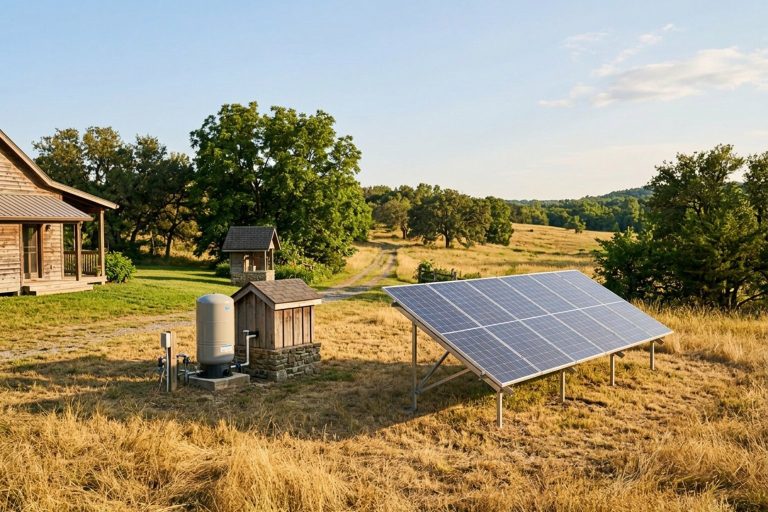
To refill a 5.1 kWh night of 12,000 BTU cooling at 5 sun-hours, you need roughly 1.3 kW of panels, on top of whatever the unit and the rest of the cabin use during the day.
NREL’s solar planning guidance gives the formula: array kW times insolation times about 0.8 for system losses. Its own example is a 3 kW array at 5 kWh per square meter per day producing about 12.0 kWh a day. NREL also notes that solar resource runs about 3.0 to 6.0 kWh per square meter per day across most of the continental U.S.
| Daily energy to replace | Array at 3 sun-hours | Array at 5 sun-hours | Array at 6 sun-hours |
|---|---|---|---|
| 5 kWh | 2.1 kW | 1.25 kW | 1.0 kW |
| 10 kWh | 4.2 kW | 2.5 kW | 2.1 kW |
| 15 kWh | 6.3 kW | 3.75 kW | 3.1 kW |
| 20 kWh | 8.3 kW | 5.0 kW | 4.2 kW |
Source: calculated with NREL’s planning factor of about 20% system losses from NREL’s solar and storage primer. Daily energy should include daytime running, not just the night.
A worked example: a 12,000 BTU unit cooling a cabin for 24 hours at the 553 W seasonal average uses about 13.3 kWh, plus inverter loss. At 5 sun-hours that calls for an array around 3.5 kW. In practice many cabins let the temperature drift at night and run the unit hard in the afternoon, when panels can feed it directly.
Can a mini-split heat an off-grid cabin in winter?
Yes, but winter is the hardest season for solar. Heating draws more than cooling, and short winter days cut solar production, sometimes toward the low end of NREL’s 3.0 to 6.0 range.
The Hessaire 12,000 BTU unit lists a heating COP of 3.45, meaning it delivers about 3.45 units of heat per unit of electricity at rated conditions. Its working range for heating goes down to -4°F. ENERGY STAR defines HSPF2 as seasonal heating delivered divided by energy used, measured for a cold region that includes Minnesota and the Dakotas; MRCOOL lists its 12k unit at 10.2 HSPF2 in region IV. Even so, battery storage for long winter nights adds up fast, as the heating rows above show. Many off-grid owners pair a mini-split for summer cooling and shoulder seasons with a wood stove for deep winter. See our guide to sizing a wood stove for an off-grid cabin.
What size mini-split does a small cabin need?
MRCOOL rates its 12,000 BTU unit for 350 to 500 square feet. Hessaire lists 600 square feet for its 12,000 BTU unit. Oversizing wastes battery.
Use the smallest unit that holds temperature on your hottest week. MRCOOL’s 12k product page lists 350 to 500 sq ft, and the Hessaire sheet lists 600 sq ft for 12,000 BTU, 800 sq ft for 18,000, and 1,200 sq ft for 23,000. These are marketing ranges, not a load calculation. Insulation and shading do more for an off-grid cabin than a bigger compressor, because every BTU you keep out is a watt-hour you never store.
How does the mini-split fit with the rest of the cabin power budget?
The mini-split will dwarf most other loads. A DC fridge uses about 0.5 kWh a day, while a 12,000 BTU mini-split can use 5 to 10 kWh in a night.
That gap is why we cover each system separately. Read propane vs solar refrigerators for the fridge load and composting toilets for off-grid cabins for a near-zero sanitation load. If a well pump shares the same battery, check power station sizing for a well pump so the pump’s start surge does not trip the inverter while the mini-split is running.
Bottom line
A 12,000 BTU inverter mini-split draws about 950 W cooling and 1,100 W heating at rated output, and about 553 W on a seasonal average. For a 10-hour night, plan about 6.4 kWh of LiFePO4 battery at half output and about 12.6 kWh at full output, then add roughly 1.3 kW of panels per 5 kWh to refill it at 5 sun-hours. Cooling on solar is very doable. Winter heating on batteries alone gets expensive, so many cabins add wood heat.
FAQ
Can a 5 kWh battery run a mini-split all night?
Only a small unit at low output. A 12,000 BTU mini-split at half its 950 W rated input uses about 5.1 kWh over 10 hours including inverter loss. A single 5.12 kWh LiFePO4 module at 80% depth of discharge gives about 4.1 kWh usable, so it falls short. Plan at least 6.4 kWh.
How many solar panels do I need for a 12,000 BTU mini-split?
Roughly 1.3 kW of panels per 5 kWh you need to replace each day at 5 sun-hours, using NREL’s 20% loss factor. Running a 12,000 BTU unit around the clock at its seasonal average of about 553 W uses about 13.3 kWh, which calls for roughly 3.5 kW of solar.
Is 120V or 240V better for an off-grid mini-split?
For 12,000 BTU and below, 115V units are common and work with single 120V inverters. The Hessaire and MRCOOL 12k units are both 115V. Larger units, such as Hessaire’s 18,000 and 23,000 BTU models, are 230V and need a split-phase or 240V-capable inverter.
Do I need a special inverter for a mini-split?
You need a pure sine wave inverter with continuous output above the unit’s heating input. Victron’s MultiPlus-II 48/3000 120V is rated 2,400 W continuous at 25°C, enough for a 115V 12,000 BTU unit. A 230V unit needs a 240V-capable or split-phase setup. Also count idle draw, 11 W for that model.
What is the difference between EER2 and SEER2?
Both measure cooling per watt-hour. ENERGY STAR defines EER2 as cooling delivered divided by electricity used at a set test point, and SEER2 as total seasonal cooling divided by seasonal energy. Use EER2 to size your inverter for peak draw, and SEER2 to estimate average daily battery use.
As an Amazon Associate I earn from qualifying purchases. Offsprig may earn a commission on links in this guide at no extra cost to you.
Updated October 2026. Watt figures come from manufacturer spec sheets; battery and solar sizing are our worked estimates using those figures and NREL planning factors. Your real use depends on climate, insulation, and thermostat setting.